

The way SaaS buyers discover and evaluate software has shifted. Traditional SEO still matters. Buyers still use Google to sense-check claims, compare pages, and dig into the details. But more of the first pass now happens inside AI tools like ChatGPT, Perplexity, and Google’s AI Mode. For B2B software brands, that matters because the shortlist is often taking shape before a prospect lands on your site.
The best agencies are not treating this as a shiny new side project. They see AI search optimization as part of the same job organic search has always been trying to do, get your brand in front of the right buyer at the right moment. That means building technical clarity, stronger authority signals, and content that can surface in both traditional search and AI-driven discovery. This guide compares ten agencies with different strengths so you can find the right fit for your stage, resources, and growth goals.
Common Characteristics the Best Agencies Share
Picking an AI search optimization agency takes more than counting citations or screenshots from ChatGPT. The strongest partners tend to get a few core things right, and they do it consistently.
Deep understanding of modern buying journeys
A good agency needs to understand how software buying works in the real world. B2B SaaS deals are rarely quick. There are longer sales cycles, more people involved, and more comparison points along the way. The right partner knows how to show up when a buyer moves from broad research into real evaluation. That is the point where visibility starts turning into commercial value.
Strong traditional SEO foundations
AI visibility does not sit on its own. It rests on the same foundations that support strong organic search in the first place. If a site is hard to crawl, technically messy, or thin on clear signals, it becomes much harder for search engines and AI systems to interpret it with confidence. The best agencies still care about technical SEO, structured data, internal clarity, and content architecture because those basics still do a lot of the heavy lifting.
AI visibility tied to revenue
A mention in an AI answer is not the goal. It is only useful if it helps move someone closer to a demo, a trial, or a sales conversation. Strong agencies keep coming back to commercial outcomes. They want to know whether visibility is driving qualified pipeline, not whether it looks good in a monthly report.
Authority across trusted sources
AI systems lean heavily on outside validation. That is why authority matters so much here. Agencies that do this well look beyond your own website. They push for stronger brand mentions, better review coverage, solid digital PR, and visibility in the places buyers already trust. That might mean G2, Capterra, Reddit, industry listicles, or niche publications. The point is the same, build enough external proof that your brand looks credible wherever AI systems go looking.
Clear reporting and the “so what?†factor
This is where weaker agencies often fall down. They can show activity, but not business impact. The better ones connect the dots. They explain what changed, why it matters, and whether it is influencing pipeline, demos, or acquisition costs. That makes reporting far more useful for leadership teams who do not care about technical jargon unless it affects revenue.
Our Pick: The 10 Best AI Search Optimization Agencies in 2026
Before we dive into full detail, here’s a table breaking down each agency.
| Agency | Best for | Standout strength |
| Platypus SEO | Growth-stage European vertical B2B SaaS companies | Revenue-aligned SEO, AI visibility, content marketing and CRO |
| Directive | Enterprise B2B SaaS | Customer Generation and pipeline focus |
| Skale | Chasing ARR growth | Revenue-led SEO and AI search |
| Omniscient Digital | Content-led organic growth | Editorial authority and organic growth systems |
| MADX | Performance-led SaaS growth | Speed, momentum, and technical AI visibility |
| Embarque | Scalable execution | Programmatic SEO and scalable execution |
| First Page Sage | Established SaaS firms | Thought leadership and long-term authority |
| Flying Cat Marketing | Buyer-journey alignment | Buyer-journey content and trust-building visibility |
| Gripped | Integrated demand gen | Integrated demand generation support |
| iPullRank | Technically complex sites | Technical depth and relevance engineering |
Now let’s dive into full detail.
1. Platypus SEO
Best for: Growth-stage European vertical B2B SaaS companies that want AI search visibility tied to qualified pipeline, demos, and revenue.
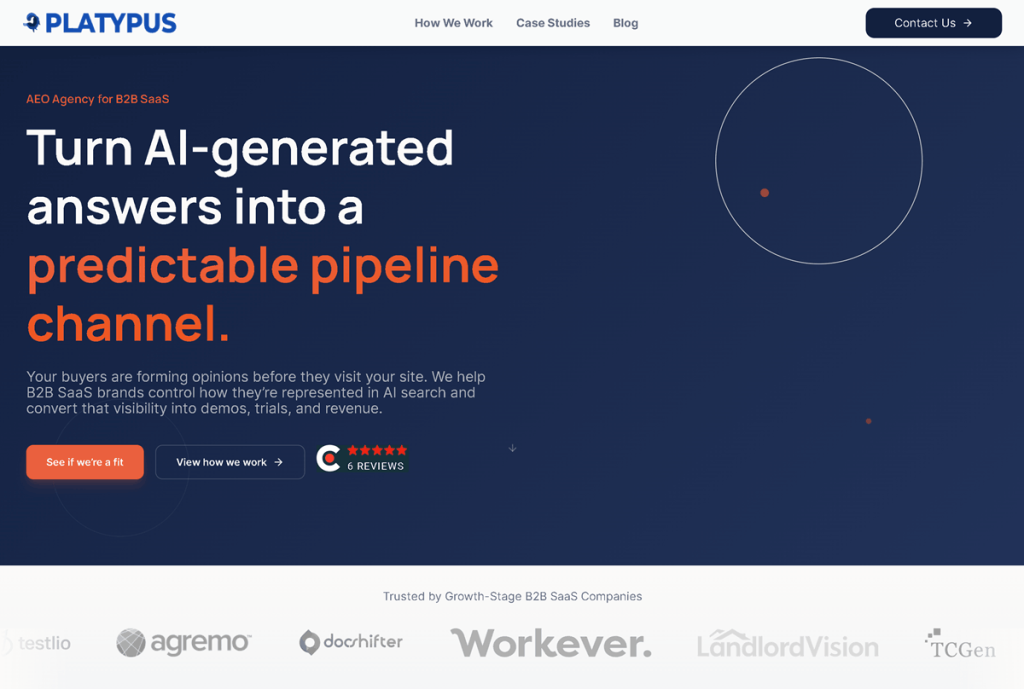
Platypus SEO does not present AI search as a separate service bolted onto traditional SEO. It treats AI visibility as part of a broader organic growth system built to drive commercial outcomes. That is a meaningful distinction. The agency works with growth-stage European B2B SaaS companies that expect search to contribute to pipeline, not simply traffic. The focus is on qualified demand, demos, free trials, and revenue, which gives the offer a much sharper commercial edge than agencies still talking mainly about rankings or visibility in the abstract.
There is also a clear fit element here. Platypus is built for companies that want a partner embedded in the work, not sitting at arm’s length. The team operates more like an extension of internal marketing and growth functions than an outside supplier. That matters in B2B SaaS, where search needs to line up with positioning, funnel stages, and real commercial priorities. Their work across traditional SEO and AI search runs in parallel, with an emphasis on showing up in the places modern buyers and AI systems actually use during evaluation, from search engines to review sites, communities, and industry roundups.
Core Services
- Search Engine Optimization
- AI Search Optimization (AEO / GEO)
- Content Marketing
- Conversion Rate Optimization (CRO)
Potential Limitation
Platypus is not a fit for broad, generalist digital marketing support or for companies without a clear go-to-market strategy. It makes more sense where search is expected to play a meaningful role in revenue.
2. Directive
Best for: Mid-market and enterprise B2B SaaS brands that need AI search integrated into a wider growth system.
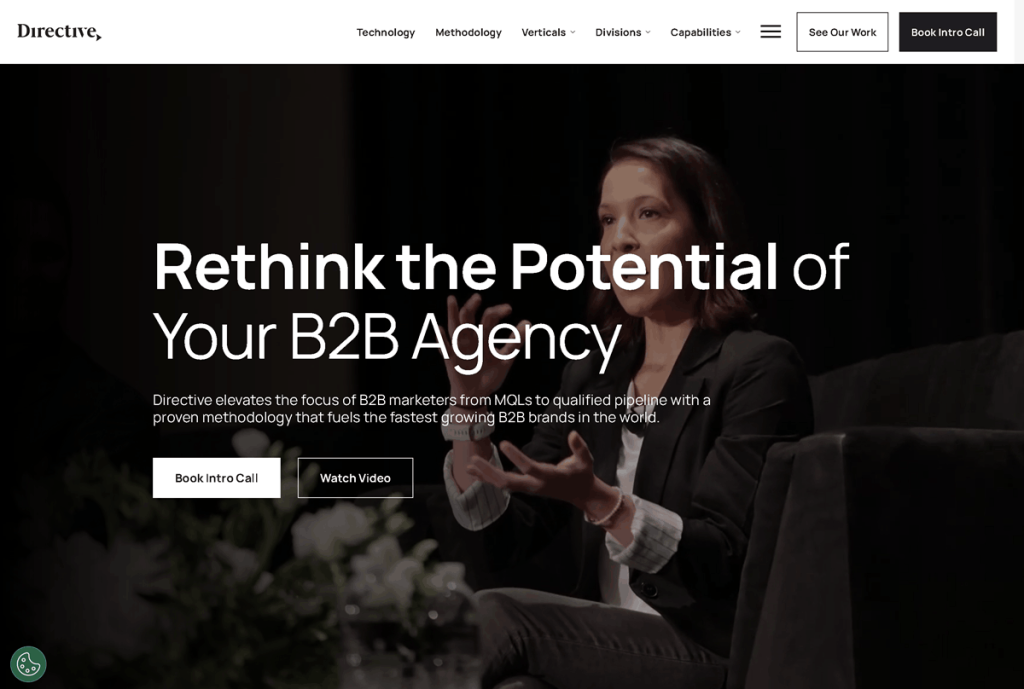
Directive is a strong fit for companies that need AI visibility to sit inside a much bigger commercial machine. Its positioning is less about isolated search wins and more about how search contributes to pipeline, CAC efficiency, and broader demand generation. That’s why it tends to appeal to larger B2B SaaS teams. The value is not only in getting cited by AI systems, but in understanding what those citations mean for acquisition and revenue.
It’s also well suited to more complex internal environments. Directive works best when SEO cannot operate on its own and has to line up with paid media, reporting, and wider performance goals. That makes it a sensible option for enterprise or mid-market teams with multiple stakeholders and higher reporting expectations. If a business wants AI search optimization to feed into a larger growth framework rather than run as a standalone channel, Directive has a strong case.
Core Services
- B2B SEO & PPC services
- Conversion optimization
- Demand generation strategy
Potential Limitation
Its broad service mix and enterprise focus may be more than a smaller SaaS team needs if they are looking for a more nimble, specialist-led SEO partner.
3. Skale
Best for: SaaS brands that want GEO and AEO support from a partner focused on ARR and MRR.
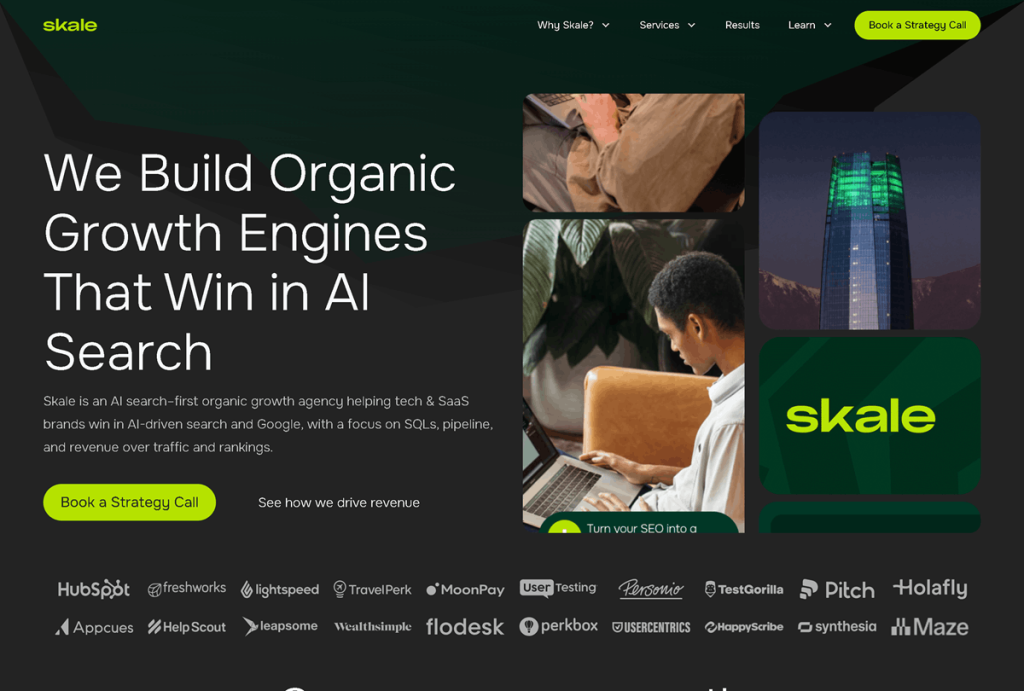
Skale immediately feels more commercial than most agencies because it talks in the language SaaS teams already use internally. ARR, MRR, pipeline, signups. That framing matters. It makes the service feel closer to growth planning and less like a disconnected SEO workstream. For SaaS companies under pressure to justify spend against outcomes, that is a real strength.
The other reason Skale stands out is fit. It is built for teams that want search work tied tightly to revenue, not spread across a long list of softer awareness goals. Its positioning reflects the shift in how people now research software, with more discovery happening across chat-based tools as well as traditional search. The emphasis stays on the commercial side of that change. Not visibility for its own sake, but the kind of visibility that helps move prospects toward trials, demos, and pipeline. That makes Skale a strong option for businesses that want a growth-minded partner and clear financial logic behind the work.
Core Services
- SaaS SEO strategy
- AI search optimization & GEO
- Link building and authority growth
Potential Limitation
Brands that need heavier support around brand-led content or top-of-funnel awareness may find Skale’s revenue focus a little narrow.
4. Omniscient Digital
Best for: B2B software companies that want editorial authority and organic growth systems to work together.
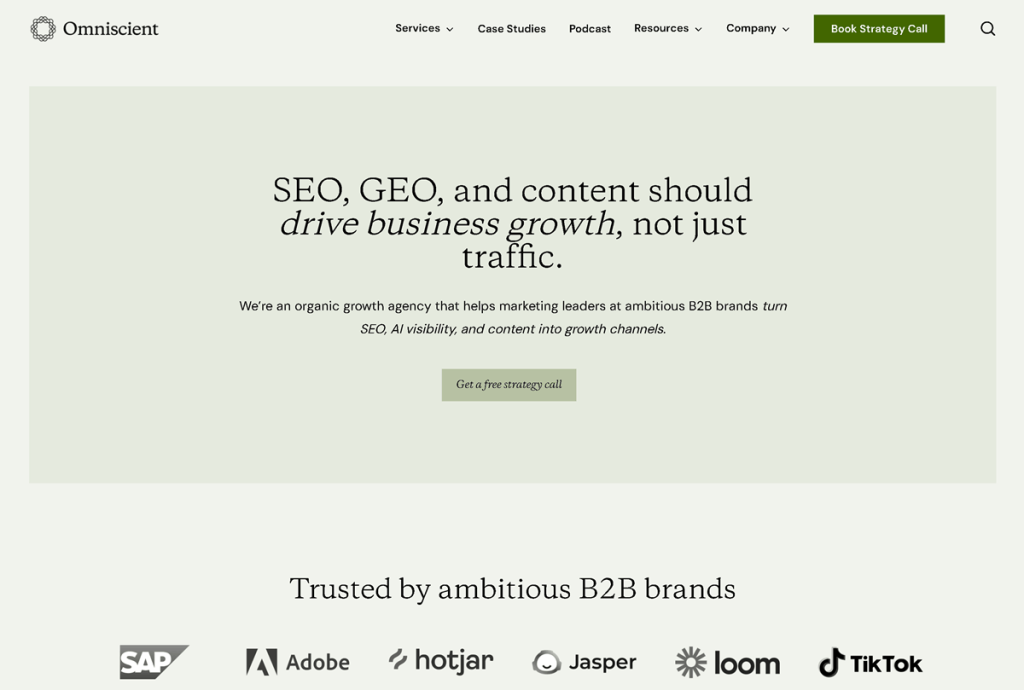
Omniscient Digital makes the most sense for teams that see content as a serious growth asset, not a support function. Its strength is in building authority through high-quality, expert-led content that can perform in both traditional search and AI-driven environments. That is especially useful in complex software categories where credibility matters and thin content will not cut it.
The appeal is not speed for the sake of speed. It is the ability to build a durable content system that keeps educating buyers, reinforcing trust, and strengthening search visibility over time. For SaaS brands that want their content engine to do more than publish blog posts, Omniscient is a strong option. It is better suited to companies that value depth, quality, and long-term organic growth than those chasing quick tactical wins.
Core Services
- Content strategy & Organic growth systems
- Generative Engine Optimization (GEO)
- Technical SEO & Site infrastructure
Potential Limitation
Its consultative, strategy-led approach may feel slow for brands that want rapid execution without investing heavily in content depth.
5. MADX
Best for: Fast-moving SaaS brands that want performance-led technical SEO and AI search visibility.
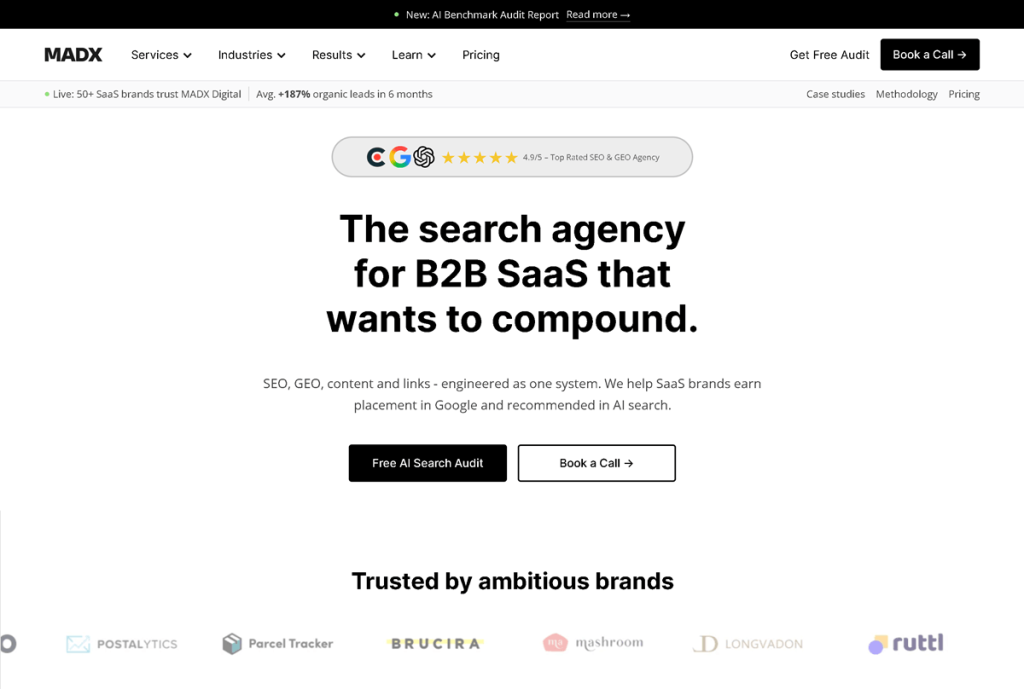
MADX feels built for companies that want speed. That is part of the appeal. The agency leans into technical implementation and fast action, which makes it a good fit for SaaS teams that want momentum rather than a long strategic runway. In crowded categories, that can matter a lot. Sometimes the issue is not direction, but pace.
It also has a more aggressive feel than some of the other agencies on this list. The positioning suggests a partner that is comfortable pushing hard on technical fixes, authority building, and visibility gains without overcomplicating the message. That will suit some businesses far more than others. For teams that want a modern, performance-led approach and are comfortable with a quicker tempo, MADX is an easy shortlist option.
Core Services
- Performance SaaS SEO & GEO
- Technical SEO Audits
- Authority building and Link building
Potential Limitation
Its faster, more performance-driven pace may not suit larger or more conservative organizations that want a slower, more consultative process.
6. Embarque
Best for: SaaS teams that value scalable execution, programmatic SEO, and AI answer visibility.
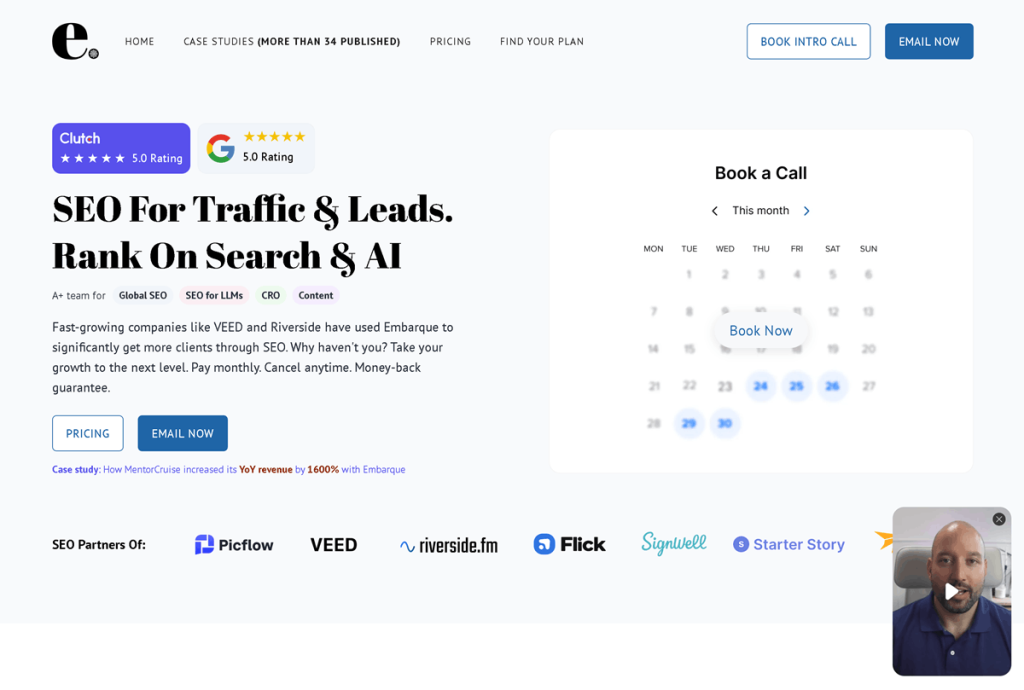
Embarque is a practical option for companies that need coverage at scale. That is the core attraction. Where some agencies lean hard into strategy, Embarque feels more execution-led. It suits SaaS businesses with lots of use cases, large page sets, or broader search footprints that need to be built out efficiently.
That does not make it simplistic. It makes it useful for a specific type of buyer. If the challenge is not deciding what to do, but getting a large amount of work done well and at speed, Embarque has a stronger case than more boutique or advisory-led agencies. For lean teams that want to expand search visibility without building a large internal engine first, that kind of delivery model can be very appealing.
Core Services
- Programmatic SEO & Scalable content
- AI search visibility (GEO/AEO)
- SaaS content strategy
Potential Limitation
Brands looking for high-touch CRO support or deeper thought leadership work may find Embarque’s execution-first model less suited to those needs.
7. First Page Sage
Best for: Mature software brands that want long-term authority, thought leadership, and steady organic visibility.
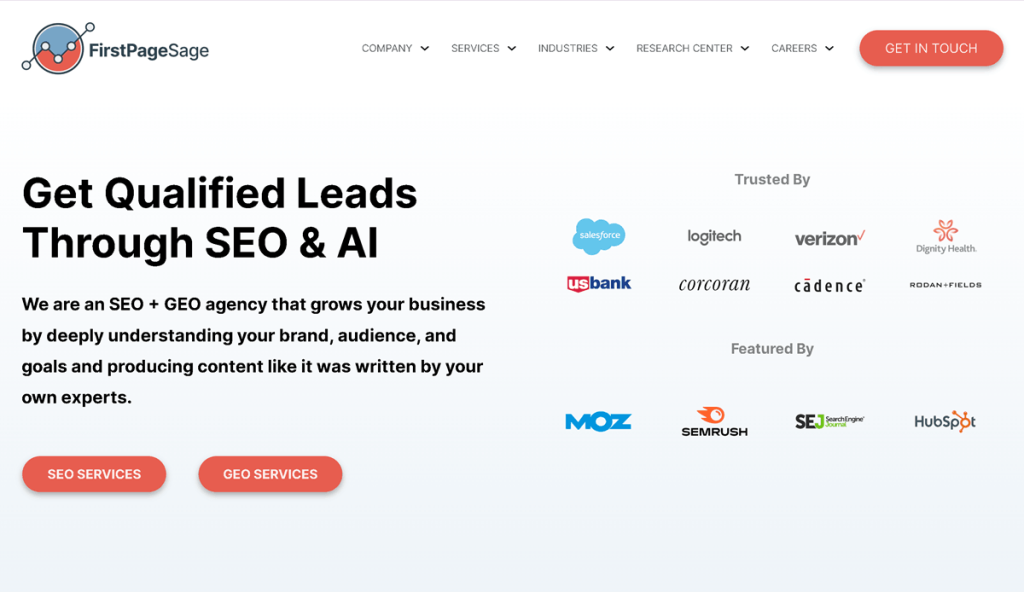
First Page Sage makes more sense for established companies than for startups chasing quick movement. Its model is built around long-term authority. That means expert-led content, deeper topical coverage, and a slower, more deliberate approach to search growth. For the right buyer, that is a strength, not a weakness.
The appeal is stability. Some companies want a partner that is less focused on rapid experimentation and more focused on building a body of work that keeps paying off over time. That is where First Page Sage fits. In a search environment shaped more and more by summaries and recommendations, being seen as a credible source matters. This agency is better suited to brands that want to invest in that kind of trust over the long haul.
Core Services
- Thought leadership SEO
- Technical SEO & Infrastructure
- Competitive analysis
Potential Limitation
Its longer-term, process-driven model may feel too slow for early-stage companies that need faster momentum or more immediate performance gains.
8. Flying Cat Marketing
Best for: SaaS brands where buyer-journey content and trust-building visibility are central to growth.
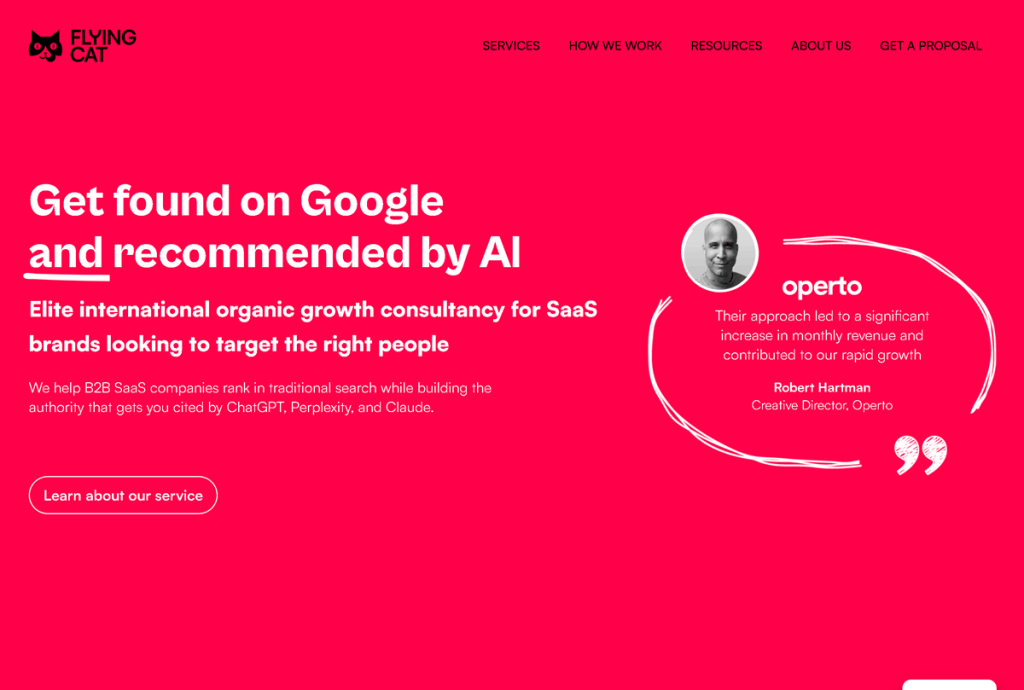
Flying Cat Marketing is a strong fit for companies that want content tied closely to how people actually buy. That is the main difference here. The agency’s value is not simply producing content that ranks. It is creating content that supports evaluation, answers objections, and helps move a buyer closer to a decision.
That makes it especially useful in categories where trust matters and buyers need more education before they convert. For SaaS teams that see SEO as part of a wider trust-building process, Flying Cat has a clear role. It is not the most technical or aggressive option on this list, but it does have a stronger editorial and buyer-alignment angle than most.
Core Services
- Content strategy & Editorial production
- Buyer journey mapping
- SaaS SEO execution
Potential Limitation
Companies with deeper technical SEO issues may need extra internal support, or a more technical partner alongside Flying Cat’s editorial-heavy approach.
9. Gripped
Best for: B2B SaaS and AI companies that want AI visibility to sit inside a broader demand generation engine.
Gripped is a good option for companies that do not want search handled in isolation. That is really the point of the offer. It brings AI visibility, SEO, paid media, and web support into a wider growth setup, which makes it more relevant for teams that want coordination across channels rather than a narrow search specialist.
That wider lens will suit some buyers far better than others. If a company is trying to build out demand generation more broadly and wants one partner to connect the dots, Gripped has an obvious appeal. It is less about pure search depth and more about how search fits into the whole acquisition model. For businesses that need joined-up support, that can be more useful than a narrower, specialist-only relationship.
Core Services
- Integrated SaaS SEO & GEO
- Paid media & PPC services
- Web development & CRO
Potential Limitation
For teams that want a pure-play AI search or technical SEO specialist, Gripped may feel broader than necessary.
10. iPullRank
Best for: Technology companies that want a technical, engineering-led approach to AI visibility.
iPullRank stands out on technical depth. That is the clearest reason to include it here. The agency is best suited to companies that want to understand how search systems interpret, retrieve, and weight information, rather than simply aiming for more visibility at a surface level. For technically complex brands, that can be a major advantage.
It is also a very specific kind of fit. Some teams want a partner that can go deep on technical structure, entity signals, and relevance. Others do not need that level of complexity. iPullRank is for the first group. For enterprise or technically demanding sites, that engineering-led mindset can make the agency one of the more credible options on the list.
Core Services
- Technical SEO & Relevance engineering
- Entity optimization & LLM retrieval
- Content engineering
Potential Limitation
Its technical depth may be more than smaller SaaS brands need, especially if their sites are relatively simple and their main challenge is strategic focus rather than engineering complexity.
Frequently Asked Questions
An AI SEO agency helps brands improve how they appear across AI-driven discovery tools like ChatGPT, Perplexity, and Google AI overviews. In practice, that usually means improving the chances that your brand is cited, summarized, or recommended when buyers ask category or vendor-related questions.
Yes. AI visibility does not replace traditional SEO. It builds on it. If your site is technically weak, hard to crawl, thin on useful content, or lacking authority signals, AI search platforms have less reason to trust or reference it. Strong organic search foundations still do a lot of the work.
Usually by improving the same signals that make a brand easier to trust online. That can include stronger technical SEO, better content structure, clearer entity signals, more authoritative mentions, improved review coverage, and visibility across the third-party sources AI systems are likely to draw from.
Traditional SEO is mostly about improving visibility in search results and earning clicks to your site. AI search optimization is more focused on helping your brand appear inside generated answers, summaries, and recommendations. The overlap is significant, but the way visibility shows up is different.
Usually months, not weeks. In most cases, it follows a similar timeline to organic search. Some technical or authority improvements may show up earlier, but meaningful impact on qualified leads, demos, or pipeline tends to build over time rather than overnight.
Why AI Search Optimization Matters in 2026
In B2B SaaS, buyers rarely move in a straight line. They compare options, revisit the market, ask narrower questions, and look for outside validation before they ever book a demo. More of that activity now happens inside AI tools. People are asking for recommendations, alternatives, pros and cons, and shortlist-style answers before they visit a vendor website.
That changes what visibility means.
If your brand is missing from those answers, you are not only losing clicks. You may be missing the shortlist entirely. For SaaS companies in particular, that matters because the buying journey is longer, more comparison-heavy, and often shaped by trust signals long before someone fills out a form.
AI search optimization matters for a few practical reasons:
- It can influence the shortlist early. If your brand is not mentioned when a buyer asks for the best tools in your category, you may be out of the running before the real evaluation even starts.
- It rewards trust, not only volume. Mentions on review sites, trusted publications, communities, and third-party roundups can carry more weight than publishing more pages for the sake of it.
- It still depends on strong SEO basics. AI visibility is stronger when it sits on top of clean technical SEO, clear site structure, useful content, and stronger authority signals.
For SaaS brands with long sales cycles, that combination matters. A buyer may not visit your site on day one, but AI-generated answers can still shape whether your company makes the next round of consideration.
Related Posts
10 Best SimpleTiger Alternatives for SEO / AEO in 2026
Compare the 10 best SimpleTiger alternatives from B2B SaaS specialists to technical, ecommerce, content, and local search experts.

Dragan Veselinović
May 29, 2026

10 Best Skale Alternatives in 2026
Skale has built its reputation by rejecting the old traffic-first agency model. Instead of chasing rankings for their own sake,…
Dragan Veselinović
May 25, 2026