
TL;DR
Comparing First Page Sage alternatives in 2026? The right partner depends on your stage, your category, and whether AI search visibility now sits inside the brief. Here’s our shortlist:
- Platypus SEO: growth-stage European B2B SaaS that wants organic and AI search tied to pipeline.
- Stratabeat: mid-market and enterprise SaaS that want a data-led authority play with real AEO.
- Powered by Search: teams that want SEO run inside a guaranteed pipeline program.
- Graphite: hyper-growth SaaS chasing programmatic and AI search scale.
- uSERP: brands that need earned authority and citations for AI answers.
- Bay Leaf Digital: SaaS teams wanting full-funnel marketing under one roof.
- Codeless: companies that need content volume without losing editorial quality.
- NUOPTIMA: European SaaS wanting a senior, full-stack growth partner.
- Accelerate Agency: SaaS that want data and machine learning driving SEO at scale.
- Optimist: lean teams that want a compounding, revenue-led content program.
If you’re paying First Page Sage a premium retainer for a handful of long-form articles each month, and you’re waiting the better part of a year to learn whether the investment works, you’re not the only one rethinking the arrangement. Plenty of B2B SaaS teams reach the same point. The model still produces good content, yet the economics and the timelines don’t always match how fast a software company needs to move.
Something bigger has shifted too. Buyers no longer start and finish their research on Google. Increasingly, they ask ChatGPT, Perplexity, Gemini, and Google’s AI Mode for shortlists, comparisons, and alternatives long before they reach your site. So strong SEO content alone no longer covers the brief. You need visibility across traditional search and AI-driven discovery at the same time.
This guide gives you three things. First, a fair read on what First Page Sage does well and where it falls short. Second, a clear framework for judging any alternative. Third, ten agencies worth shortlisting, each mapped to the situation it suits best. Let’s start with the incumbent.
What First Page Sage does well, and where it fits
First Page Sage has earned its reputation, so it’s worth being fair before we get to the friction. Evan Bailyn founded the US-based agency back in 2009, and it has spent well over a decade building authority-led SEO for enterprise software and technology brands. If you value a long track record, that history counts for something.
Its signature is thought-leadership SEO. The team produces long-form, analyst-style content designed to win trust with senior buyers, and it published an early framework for generative engine optimization that helped shape how the category talks about AI search today. Naturally, its client base leans enterprise, with large, recognizable software and tech names.
So who does it actually suit? Established firms with longer planning horizons tend to get the most from them. If you want content that compounds in authority over several years, and you’re comfortable trading speed for depth, First Page Sage fits that brief well. The friction shows up when your priorities point in a different direction, which is exactly where pricing comes in.
First Page Sage pricing, and what you really commit to
You want the numbers, so let’s be direct about them. First Page Sage doesn’t publish flat, self-serve pricing. Instead, it quotes custom retainers, and reported ranges give you a rough sense of the commitment before you ever get on a call.
| Tier | Reported monthly | What it covers |
| Content-led | ~$3,500 to $7,500 | SEO-focused content production |
| Full-service GEO / AEO | ~$12,000 and up | Strategy, thought leadership, CRO, SME input |
| Enterprise retainer | ~$8,000 to $20,000+ | Full-service enterprise B2B campaigns |
| Consulting | ~$200 to $300 / hour | Premium advisory tier |
Engagements typically carry a minimum project investment and a six to twelve month commitment, and even the top enterprise tier reportedly produces only a few articles each month. For a slow, authority-first strategy, that can make sense. For a team that needs broad topical coverage quickly, though, the output per dollar starts to feel tight. That tension explains why so many teams begin looking elsewhere.
How we evaluated these alternatives
Here’s how we weighed each agency. We looked at eight things.
- Revenue alignment. Does the agency optimize for pipeline, demos, and trials, or does it stop at rankings and traffic? The strongest partners treat search as a commercial system, which sits at the heart of a B2B SaaS SEO program built around revenue.
- B2B SaaS fluency. Long sales cycles, multiple stakeholders, and the difference between product-led and sales-led growth all shape the work.
- Intent-led keyword work. The best teams chase high-intent demand rather than raw volume, and they start by mapping keywords to buyer intent across the funnel.
- AI search readiness. Look for an explicit method for earning citations in AI answers, not traditional SEO with the word AI stapled on top.
- Technical depth. Clean architecture and crawlability set the ceiling for both rankings and AI retrieval.
- Authority and off-page strength. Digital PR, reviews, and third-party citations feed the trust signals AI systems lean on.
- Engagement model. An embedded partner with senior involvement tends to outperform an arm’s-length vendor, and flexible terms beat rigid lock-in.
- Reporting that answers “so what?” Dashboards should tie back to outcomes a CFO recognizes.
One more thing before the list. This isn’t a strict one-to-ten ranking. Each agency wins in a different situation, so read it with your own stage and priority channel in mind.
Our pick: the best First Page Sage alternatives compared
Here’s the shortlist at a glance before we go deeper on each one. Use it to spot the two or three worth a closer look, then read their full profiles below.
| Agency | Best for | Standout strength | Region | AI search core? |
|---|---|---|---|---|
| Platypus SEO | Growth-stage European B2B SaaS | Revenue-aligned organic + AI search | Europe | Yes |
| Stratabeat | Mid-market and enterprise SaaS | Data-led SEO, GEO and CRO | US | Yes |
| Powered by Search | Teams that want guaranteed pipeline | SEO inside a pipeline guarantee | North America | Partial |
| Graphite | Hyper-growth SaaS scaleups | Programmatic SEO + AEO at speed | US | Yes |
| uSERP | Brands needing earned authority | Digital PR built for AI citations | US / global | Off-page |
| Bay Leaf Digital | SaaS wanting one marketing partner | Full-funnel SaaS marketing | US | Partial |
| Codeless | Teams that need content volume | Editorial content at scale | US / global | Partial |
| NUOPTIMA | Scaling SaaS across Europe | Senior-led full-stack growth | UK / Europe | Yes |
| Accelerate Agency | SaaS wanting data-led organic | Machine-learning-driven SEO | UK | Partial |
| Optimist | Lean, content-led teams | Compounding, revenue-tied content | US / global | Partial |
Now for the detail.
1. Platypus SEO
Best for: growth-stage European B2B SaaS that wants traditional and AI search tied directly to qualified pipeline, demos, and free trials.
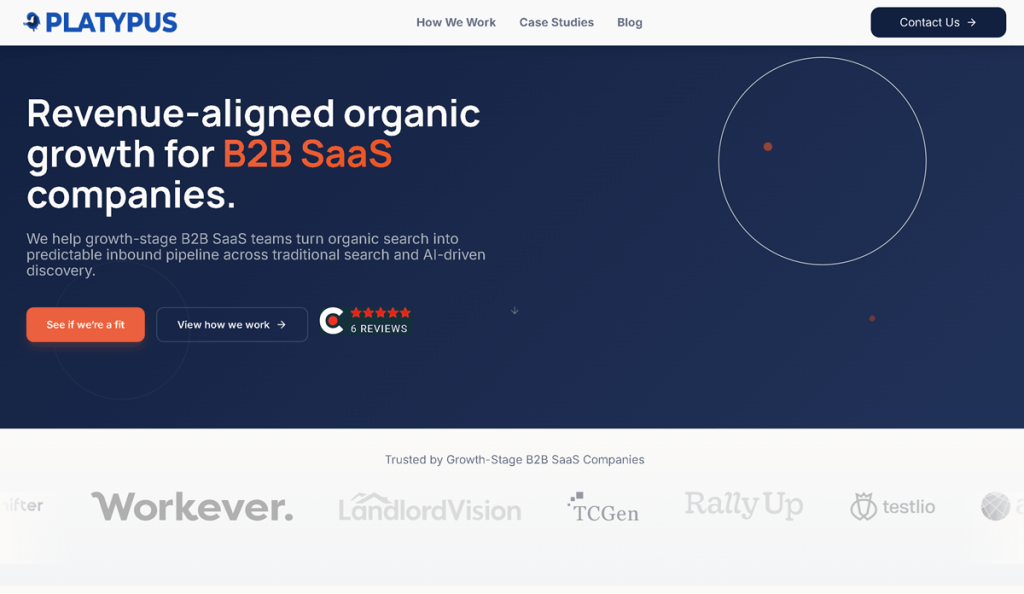
Platypus exists for one job, and it does that job deliberately. It grows organic and AI search for European B2B SaaS companies, and it ties that growth to revenue rather than traffic for its own sake. Where First Page Sage runs SEO and AI search as separate workstreams, Platypus coordinates SEO, AEO, GEO, content, and conversion work as a single system aimed at pipeline.
The team plugs in as an extension of your in-house marketing and growth function, then takes ownership of the outcome instead of servicing an account from a distance. That suits companies that already have leadership in place and want a specialist to run search end to end, across Google, Bing, ChatGPT, and Google’s AI Mode at once.
Strengths:
- Revenue-first reporting tied to pipeline and demos
- AI search built in from day one, not bolted on later
- Senior-led, embedded engagement model
Less of a fit if: you’re pre-product-market-fit, very early stage, or you want broad generalist marketing rather than focused organic growth.
2. Stratabeat
Best for: mid-market and enterprise SaaS that want the authority play First Page Sage is known for, but with deeper data and a real AI search motion.
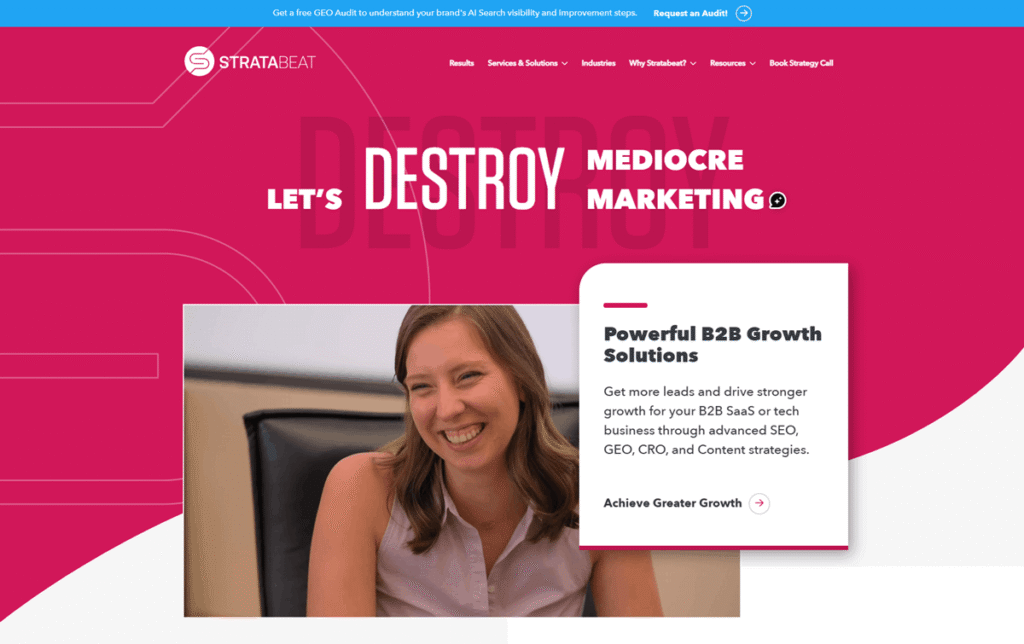
Stratabeat reads as the closest direct answer to First Page Sage on this list. The Boston agency combines SEO, generative engine optimization, conversion work, and content under one data-led method, and it has the recognition to back the approach, including a 2025 U.S. Search Award for its use of data in SEO. If you like the FPS idea of authority content but want sharper analytics behind it, this is the natural comparison.
The team leans on audience insight and conversion optimization rather than volume alone, which appeals to companies that care about content-to-buyer fit as much as rankings. For mid-market and enterprise SaaS that measure success in qualified pipeline, that balance of data and craft does real work.
Strengths:
- Award-winning, data-led methodology
- Joined-up SEO, GEO, and CRO
- Strong fit for technical and regulated categories
Less of a fit if: you need a low-cost, early-stage engagement, or you want proof centered firmly on pipeline attribution rather than visibility.
3. Powered by Search
Best for: SaaS teams that want SEO run inside a wider demand program, with accountability for pipeline rather than rankings.
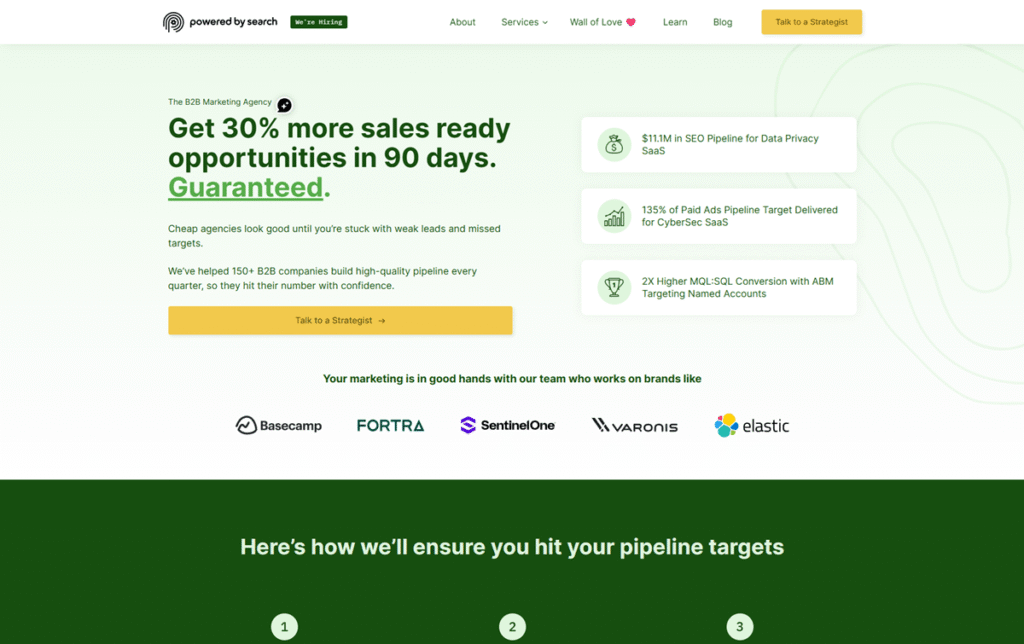
Powered by Search approaches organic search as one lever inside a pipeline engine, not as a standalone content retainer. The Toronto agency ties its work to metrics leadership cares about, such as cost of acquisition and pipeline contribution, and it backs the model with an outcome-based promise around pipeline growth. That directly answers one of the most common First Page Sage frustrations, which is the absence of any performance guarantee.
Because the team coordinates SEO alongside the rest of demand generation, it suits companies that want fewer vendors and tighter alignment across channels. If your search work keeps getting stranded from the rest of your go-to-market, this joined-up setup helps.
Strengths:
- Pipeline-focused, outcome-based positioning
- SEO coordinated with wider demand generation
- Reporting framed around revenue, not rankings
Less of a fit if: you only want a focused organic specialist and have no appetite for a broader program.
4. Graphite
Best for: hyper-growth SaaS scaleups chasing programmatic scale and AI search visibility together.
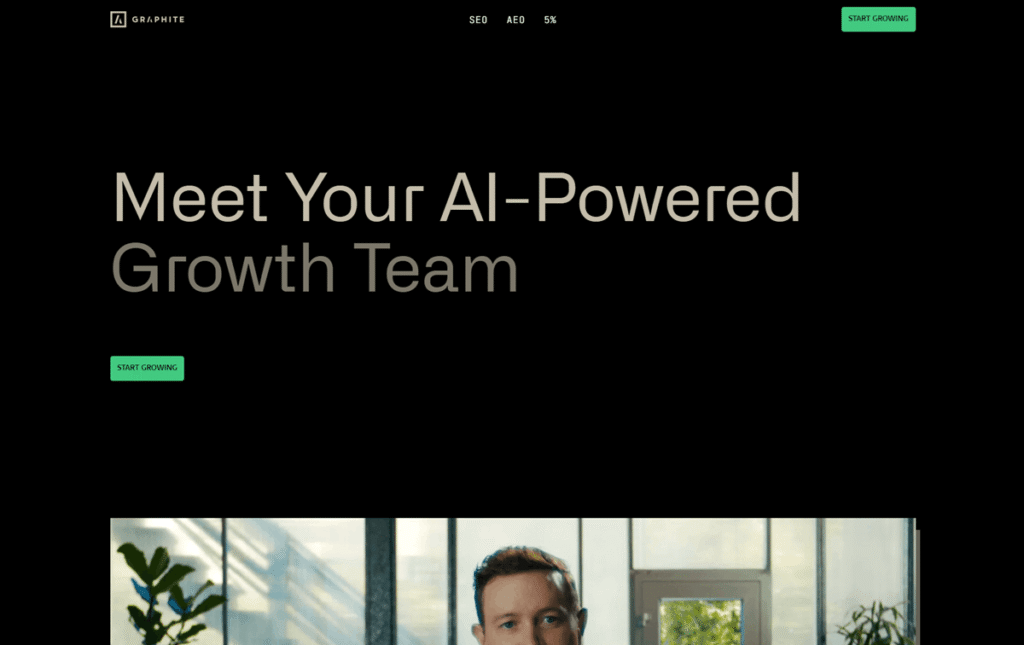
Graphite calls itself an AI-enabled growth agency. The San Francisco team works with fast-scaling tech companies and treats topical authority, programmatic SEO, and answer engine optimization as one practice rather than separate projects. Its founding thesis is blunt: most SEO effort is wasted, so it hunts for the small share of work that actually moves growth and ships against it quickly.
That high-velocity, systems-led approach suits companies that need to cover a large surface of queries fast and want AI search baked into the plan from the outset. The agency even productized its method into a platform, which signals how repeatable the system has become.
Strengths:
- Programmatic SEO delivered at speed
- AEO treated as core, not an add-on
- Built for hyper-growth scale
Less of a fit if: you’re a small or early team that needs a lighter, more hands-on touch.
5. uSERP
Best for: brands whose bottleneck isn’t on-page content but earned authority and citation share in AI answers.
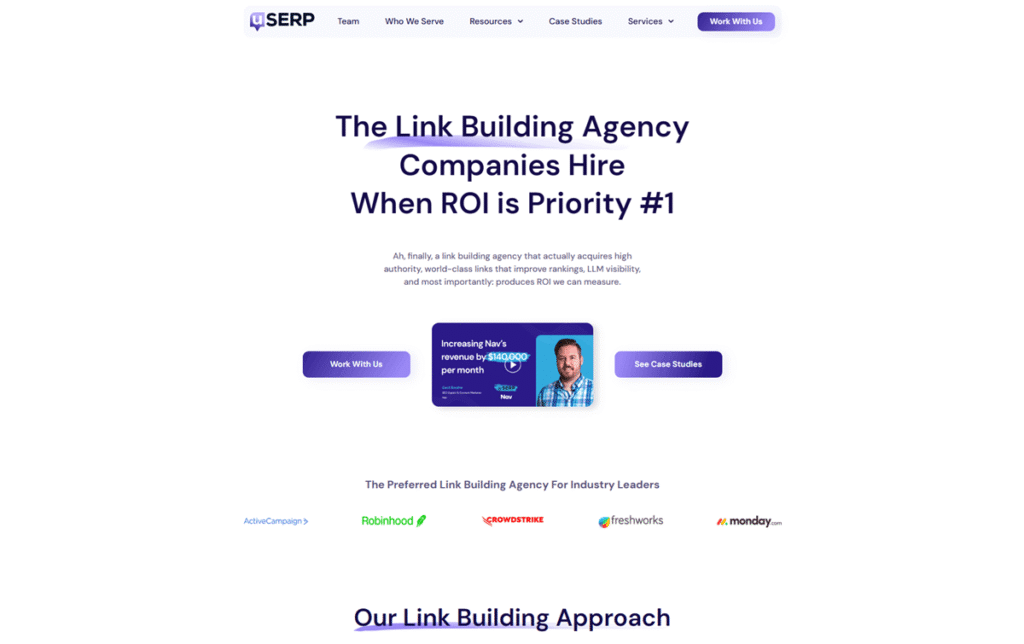
uSERP plays a different position to most agencies here. It focuses on authority building, digital PR, and high-quality link acquisition, increasingly aimed at the off-site signals that AI engines weigh when they decide which brands to mention. If your content’s already solid but you’re missing from AI shortlists, that gap usually traces back to authority, which is exactly uSERP’s lane.
Because it concentrates on earned coverage rather than full-service SEO, uSERP often works best layered on top of an existing content engine. For teams that want to move the needle on third-party trust signals, that focus reads as a strength rather than a limitation.
Strengths:
- Digital PR tuned for AI citations
- High-authority link acquisition
- Strong complement to in-house content
Less of a fit if: you need a single partner to own on-page SEO, technical work, and content as well.
6. Bay Leaf Digital
Best for: SaaS teams that want one partner coordinating organic with paid, content, and lifecycle, rather than a content-only retainer.
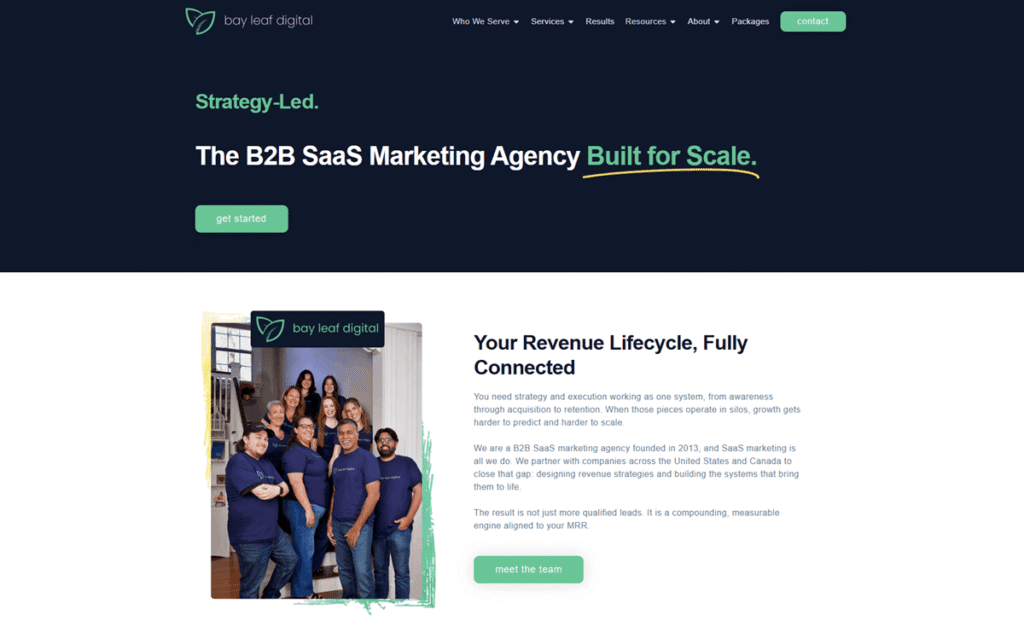
Bay Leaf Digital takes a full-funnel view of SaaS marketing. Alongside SEO, it runs paid search, content, marketing automation, and analytics, which lets a leaner team consolidate several functions under one roof. Where First Page Sage concentrates on authority content, Bay Leaf spreads across the channels that move a SaaS funnel from first touch to closed revenue.
That breadth suits companies that want coherent reporting across paid and organic and don’t want to manage a stack of separate specialists. So if your priority is connected execution over deep single-discipline authority, this model earns a look.
Strengths:
- SEO delivered inside a multi-channel program
- Marketing automation and analytics depth
- Useful for blended acquisition reporting
Less of a fit if: you want a pure organic or technical SEO specialist with no interest in paid or lifecycle work.
7. Codeless
Best for: companies whose main constraint is producing enough genuinely good content to compete, without dropping quality.
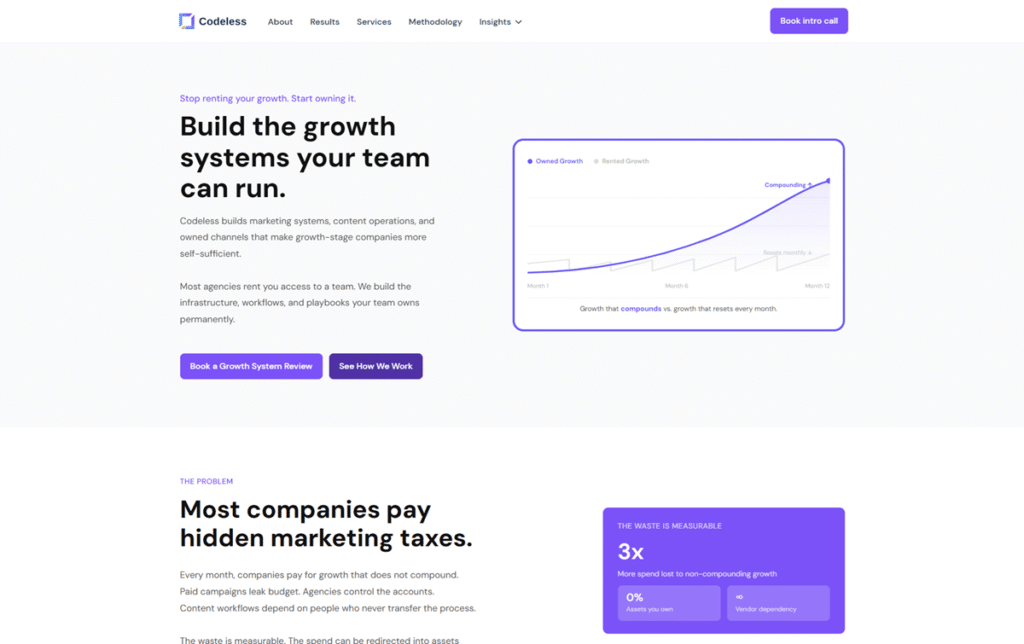
Codeless runs as a content production engine built for scale. It pairs editorial process with subject-matter input to ship high volumes of long-form content that still reads well, which directly tackles the velocity gap that pushes many teams away from First Page Sage. If you know what you want to publish but can’t produce it fast enough, this is the relevant fix.
Production at this scale works best when it sits inside a clear strategy, so pair Codeless with strong technical and authority work for a complete program. Used that way, it lets you cover a topic deeply and quickly at the same time.
Strengths:
- High-volume, editorial-grade output
- A repeatable production process
- Strong for content-led category coverage
Less of a fit if: you need full-service strategy, technical SEO, and link building from the same partner.
8. NUOPTIMA
Best for: European and UK SaaS that want a hands-on, senior growth partner rather than a US enterprise retainer.
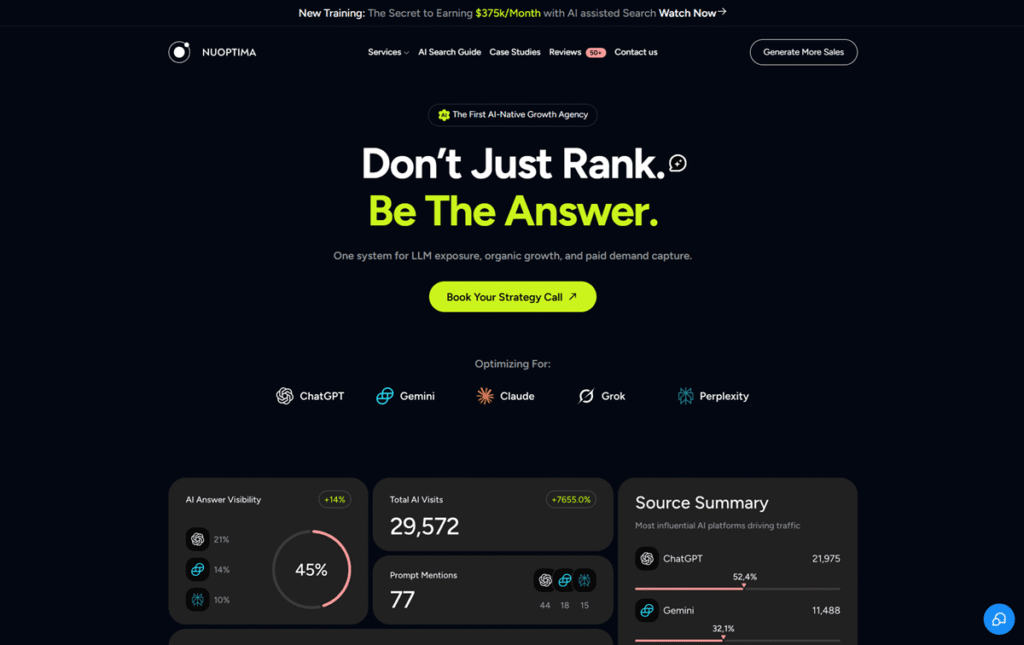
NUOPTIMA brings a full-stack growth approach to scaling SaaS, spanning SEO, content, and the wider growth function, with senior people kept close to the work. Its London base and European footprint make it a more natural fit than a US-centric agency for teams selling into European markets.
That combination of seniority and breadth suits founders and growth leads who want a partner that can flex across channels as priorities shift. If you value direct access to experienced operators over a layered account structure, the model fits.
Strengths:
- Senior-led engagements
- Full-stack growth, not SEO in isolation
- Genuine European and UK market fit
Less of a fit if: you want a narrow, deep technical-SEO pure-play rather than broader growth support.
9. Optimist
Best for: earlier-stage or lean teams that want a disciplined, content-led program tied to revenue without an enterprise price tag.
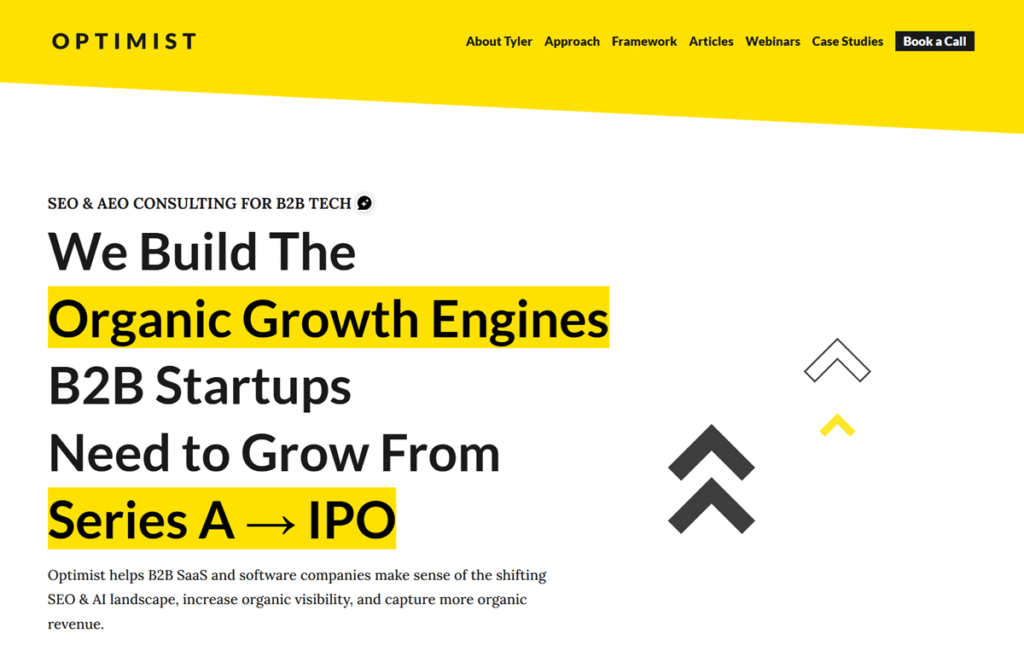
Optimist focuses on compounding organic growth for B2B SaaS, with content and SEO aimed at pipeline rather than vanity traffic. The team has worked with a large roster of tech companies and stays unusually transparent about how it judges good work, which makes it easy to hold to a clear standard.
For companies that want a focused, revenue-minded content program and don’t need enterprise-scale complexity, Optimist offers a lean, sensible path. It rewards teams that prefer steady, durable growth over quick spikes.
Strengths:
- Compounding, revenue-tied content
- A transparent methodology
- A good fit for lean teams
Less of a fit if: you need heavy technical migrations, enterprise stakeholder management, or broad multi-channel support.
How to choose the right alternative for your stage
Ten strong options is a lot to weigh, so let the decision come down to your stage, your market, and the channel you most need to own. One step first, though: before you brief anyone, run a clear-eyed audit of your own site so you know your starting point and can judge each pitch against reality. With that in hand, the mapping below narrows the field fast.
- Growth-stage European B2B SaaS, search as a revenue channel: start with Platypus SEO.
- Enterprise SaaS that wants an FPS-style authority play with more data and GEO: look at Stratabeat.
- You want SEO inside a guaranteed pipeline program: consider Powered by Search.
- Hyper-growth, chasing programmatic and AI search scale: weigh Graphite.
- You need authority and citations earned off-site for AI answers: look at uSERP.
- You need content volume without losing quality: Codeless fits.
- Full-funnel SaaS marketing under one roof: Bay Leaf Digital.
- Scaling SaaS in Europe, or a lean budget: NUOPTIMA or Optimist.
- Data and machine learning driving SEO at scale: Accelerate Agency.
Once you’ve spotted your likely match, shortlist two or three and pressure-test them against your real markets and pipeline targets before you commit.
The bottom line
First Page Sage remains a credible choice for the stage it serves, which is established firms that want authority content to compound over time. If that describes you, it earns its place. But if your friction sits with annual lock-in, slower velocity against AI-search demand, a US-centric model, or a wish to run search as a measurable revenue channel rather than a content retainer, a specialist will serve you better.
For growth-stage European B2B SaaS, that specialist is usually Platypus. Whoever you choose, hold them to the same bar: revenue alignment, technical credibility, AI search readiness, and an embedded mindset. Anything less, and you’re paying for activity rather than outcomes.
Related Posts

10 Best AI Search Optimization Agencies in 2026
This guide compares ten agencies with different strengths so you can find the right fit for your stage, resources, and…

Dragan Veselinović
May 6, 2026

10 Best GEO / AEO Agencies for B2B SaaS Brands in 2026
We compare 10 agencies with distinct specialisms, from technical seo and authority building to content strategy and AI visibility.
Dragan Veselinović
May 5, 2026