
TL;DR
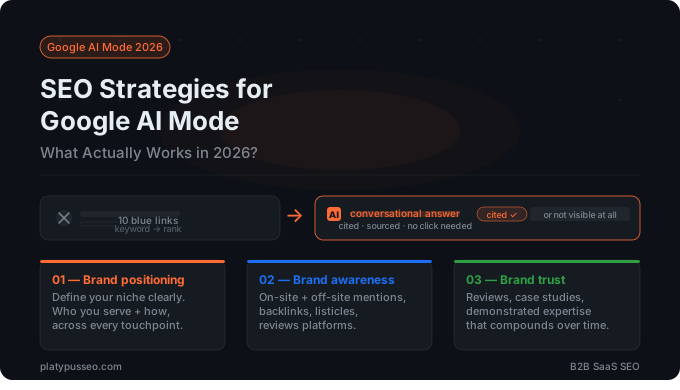
Most SEO advice for Google AI Mode is just recycled tactics (E-E-A-T, structured data, Q&A formats etc). While these still matter, they’re not what will make or break your visibility as search evolves. What will? Marketing fundamentals. Specifically: a sharp brand positioning that speaks to a defined niche, consistent brand awareness built both on and off your website, and brand trust earned through reviews and case studies. Brands that invest in these three things now will compound their visibility over time. Those that don’t will fade, regardless of how well-optimised their pages are.
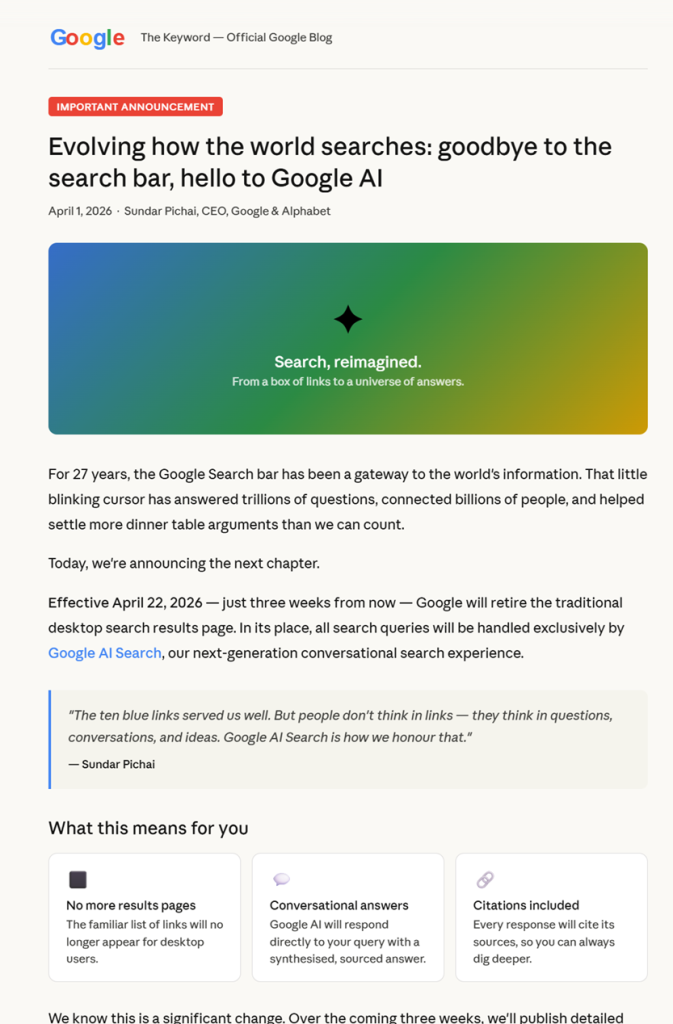
News (via a Reddit post) of Google moving to AI-only mode (see the fake image below) began circulating on April 1, 2026. And while this may have just been a redditor’s idea of an April Fool’s joke (we’ll find out on April 22nd for sure), this will be a reality sooner or later.
So, I decided to find out what the main pieces of advice are for Google AI mode. Quite frankly, I’m disappointed. Below are the most common answers I’ve found.
- Prioritize E-E-A-T: Highlight author credentials, faculty profiles, and professional bios to prove real-world expertise
- Cite credible references: Link to trustworthy sources and provide original data, research, or survey results that AI can uniquely attribute to your brand
- Use structured data: Implement schema markup to help AI agents understand your content’s context.
- Clear hierarchy: Use a logical heading structure (H2-H4) to act as a roadmap for AI crawlers.
- Anticipate follow-up questions: Structure content to answer the “why” and “how” behind a topic.
- Use Q&A Formats: Frame headings as natural questions (e.g., “How does…?”)
- Build Topic Clusters: Create “ultimate guides” and deep resources on central themes to establish yourself as a definitive research assistant for specific topics.
The above answers may not sound new to you, and that’s because they’re not.
Sadly, most advice is centered around applying SEO techniques rather than applying a strategy that will ensure your brand is recommended by Google.
So what actually works? Hint: Think fundamental marketing when it comes to building a business and brand.
What’s old is new. All that stuff you may have left for after traffic started coming through to your website will become a priority so that you’re visible at all. What am I talking about?
- Brand positioning
- Brand awareness
- Brand trust
Brands that neglect or fall behind on marketing fundamentals will perish. Those that have already or begin to invest in building their brand will benefit most long term. In other words (those of Randy Savage), “the cream will rise to the topâ€.
While this view is generally applicable to all business types, I’d like to say that Platypus primarily focuses on B2B SaaS companies. Also, this article has been written with solution-aware target audience members in mind i.e., those who are evaluating purchase options.
So let’s get started with three fundamental items that will increase your visibility on Google AI mode long term. The strategy? Call it whatever you like, it’s basically marketing 101.
Step 1: Brand Positioning
This defines what your brand stands for in the minds of customers compared to competitors (who it is for, its unique value, and why it matters).
Let’s translate this to SEO.
In the world of organic search, it’s no longer enough to describe your business as:
- An automated document management software
- A field service management software
- A penetration testing tool
- A property management software
- A HR software
You need to go deeper. Search behaviour is evolving, and search technology is doing a better than ever job of connecting searchers with the right solution(s).
Using the examples above, here’s how companies need to think of their positioning in 2026 and beyond:
- Automated document management software for life sciences, banking and insurance organisations operating in regulated industries.
- Easy to use field service management software built for tradesmen operating small teams 2 – 10 staff.
- Automated penetration testing platform for soc 2 compliance audits
- All-in-one property management software for UK landlords that want to stay MTD compliant
- MENA region specific HR software for mid-market and enterprise organisations with 100 – 5,000+ staff
So why’s this the case? Because search behaviour has changed.
You can actually go into your Google Search Console dashboard and check for yourself. Dive deep enough, and you’ll see that query lengths are now easily over 6 or 7 words long. They’re often entire sentences or paragraphs, and multi-step as well.
Previously, a six-word query would classify as long-tail. Now, these sorts of searchers are considered as just scratching the surface while a searcher builds context.
Want to check what kind of long-tail queries you’re visible for today?
Head to GSC > Performance > Add Filter > Query > By Keyword > Customer Regex > Matches Regex
Then, enter the following: [\w\W\s\S]{70,}$
You’ll now see all the truly long-tail queries that your brand shows up for. And that’s why you need to optimize “deeperâ€. Because your target audience is performing more detailed searches.
And to keep things simple, we can tie this all back to brand positioning. Define what your brand is, who you serve and how. Make sure that this is consistent across all of your messaging both on and off site.
So, step #1 make sure your brand positioning is consistent across all of your BoFu pages on your website.
Step 2: Brand Awareness
This is the “door opener” that ensures consumers recognize or recall the brand, making it part of their mental consideration set.
In SEO terms, think of it as keyword targeting and then being increasingly visible and recognised for those keywords throughout your industry.
So, now that you know who you are, what you do and who you serve. It’s time to get your message out there. Begin by writing your self-serve listicles so that Google can associate your brand with your ideal keywords.
Remember, your brand positioning needs to be consistent, so that you don’t confuse Google (or more importantly, your target market).
Now that’s part 1 of brand awareness i.e., what you do on your own website. Part 2 is what you do off site.
Previously, link building was all the buzz. It’s still relevant today, but AI search has added a new and very important layer to your strategy called building brand mentions.
In terms of practical steps, here’s some of what you can do to build brand awareness.
- Build backlinks to your articles (p.s. link back to this article if you find it useful!), contribute to industry blogs, attending events, from partner websites and more.
- Make sure your brand is mentioned across relevant industry listicles that discuss the top x solutions in your niche
- Register across review platforms (in this case B2B) like Capterra and G2 and ensure that all your information there is consistent
- Contribute to UGC platforms like Reddit and Quora (be mindful of their guidelines) across relevant threads
With the above, it’s important to remember: quality > quantity.
Do it over time. Do it well. Do it always. Six months from now, you will have built the foundations for solid brand awareness that will compound over time.
Step 3: Brand Trust
Now this step can only be developed through time, consistency (delivering results) and reliability, transforming brand awareness into loyalty and belief.
This is a step that you’re probably already taking care of, but you may not be seeing the efforts of it just yet. Maybe because you haven’t taken care of the two steps above already.
So what do I mean by brand trust? Build reviews. Build case studies. Showcase expertise.
It’s one thing to say that you can do something, but it’s a completely different ball game to prove it.
So let’s get into each.
Reviews
I want to start by saying that in all my years of SEO, I’ve yet to come across a time when building reviews was easy.
People simply have better things to do. Customers are only likely to leave a review after an incredibly good or incredibly poor experience. You don’t really see many average reviews out there, do you?
Think of it this way. Someone has paid for your product, gotten what they expect, and now they need to take extra time out of their day to voice their thoughts.
For this to happen, there really needs to be an incentive. And that’s why review building isn’t easy.
Now with all that said, it’s something that you absolutely need to do and can’t skip on, ever. Our data shows that all of our clients who successfully and consistently handled review building saw compounding growth effects year over year.
Why? Because both customers and search engines (they look at review sites to evaluate brand) gain confidence from authentic reviews.
To close off this section, I’ll provide you with links to some brands who always work on building reviews. If you conduct an audit of these (you’ll find that they’re quite well known in their field)
- Testlio: A fully managed, crowdsourced software testing platform. Just search for managed qa testing platforms on Google and see who comes up.
- Landlord Vision: A cloud-based property management software designed for UK landlords. Search for the best property management software for UK landlords and see who comes up.
- Astra Security: A global PTaaS platform. Perform a search for the best ptaas platforms and see where Astra is positioned.Â
Among all the things that these brands have done, reviews have helped make them as prominent as they are as search has evolved.
On a human level, the reviews have helped turn website visitors into customers, as you’d expect. We’ve listed major software brands, but you could apply the same principle to a coffee shop – and that’s not to talk down on coffee shops. I was once a barista!
Case Studies
Another layer you can’t afford to skip, is speaking about the results you’ve achieved.
In B2B environments, case studies are an excellent way of not only showing your capabilities, but giving insight into your processes as well.
For example, check out our B2B SaaS case studies. More than the results, readers will be interested in how we approached SEO and if it’s relatable to their business.
If the case studies make sense, and they’ve read our reviews then reaching out might make sense.
Step 4: Bringing it all together
Now all of the above would not have sounded like SEO much at all. And I can’t blame anyone who thinks so for having that view.
At a high level though, SEO is becoming less about SEO and more about building a brand and then using SEO to bring it all together.
What I mean is that, keyword targeting, technical optimization, link building, EEAT, CRO etc., are all mechanisms you use to get your brand visible in Google AI mode, but brand positioning, awareness and trust are the fundamental building blocks on which you need to do so.
Without sound marketing fundamentals, and strong SEO, your brand may appear in search now. But as search evolves, it’ll be the brands who invested in fundamentals that prevail most.
Related Posts

SEO Strategies for Cybersecurity: What Actually Builds Pipeline
Your quarterly review lands and the SEO chart looks healthy. Organic traffic is up. Non-branded sessions are growing. The blog…

Dragan Veselinović
May 14, 2026
The B2B SaaS SEO Strategy That Actually Moves Revenue
Every quarter, the same report lands on the CEO’s desk. Organic traffic is up 140 percent year over year. Non-branded…
Dragan Veselinović
Apr 20, 2026