
Your blog has dozens of posts. Your backlink profile keeps growing. You publish consistently. And yet your organic results sit flat or quietly slide. If that sounds familiar, you’re not short on effort. You’re short on visibility into what’s actually holding the site back. That’s exactly what an audit gives you.
A SaaS SEO audit is a structured review of how well a software company’s website can be found, understood, and trusted across both traditional search engines and AI answer engines. And, just as importantly, how well it converts that visibility into pipeline. It spans technical health, on-page optimization, content quality, off-page authority, AI search readiness, and the conversion paths that lead to demos or trials.
Here’s why a SaaS audit deserves its own playbook. SaaS sites carry JavaScript-heavy app frontends, sprawling URL footprints, and longer buyer journeys. Revenue depends on signups or sales conversations, not pageviews. So a generic checklist that stops at “fix your title tags” won’t get you far. You need an audit built around how SaaS buyers search and decide.
And in 2026, that means auditing two channels at once. Search has split. AI search visits grew roughly 43% year over year heading into early 2026, while traditional Google search grew only around 2%. A page can rank beautifully in Google and still stay completely invisible inside ChatGPT, Perplexity, or Google’s AI Overviews. If your audit ignores AI search, it’s auditing half the picture.
This guide walks through the full process, step by step. Let’s dive in.
1. Before You Start: Define What the Audit Is For
Before you crawl a single page, decide what the audit is meant to achieve. An audit without a northstar produces a long list of problems and no sense of which ones matter. So this first step does the most strategic work in the whole process: it ties everything that follows to revenue rather than rankings.
Set a revenue goal, not a traffic goal
Traffic feels like progress, but for B2B SaaS it’s a means, not an end. Your real destination is qualified pipeline i.e., demo requests, free-trial signups, and consultative sales calls. Traffic that never converts isn’t an asset sitting idle. Rather, it’s a cost that consumes crawl budget, dilutes your analytics, and creates the comforting illusion that SEO is working.
So frame the audit around a single question: where is the site leaking qualified buyers between the first impression and the signup? Most audits start from one of three goals. Pick yours before you begin, because it sets your priorities:
- Recover lost ground. Rankings or traffic dropped after an algorithm update, or older articles have slowly decayed.
- Fix a conversion gap. Traffic exists, but demos and trials don’t follow. The leak sits between visibility and revenue.
- Prepare for scale. You’re about to invest heavily in content and want a clean foundation first.
Map the audit to the SaaS funnel
Next, view your site through the funnel. Top-of-funnel (ToFu) content educates. Middle-of-funnel (MoFu) content helps buyers evaluate. Bottom-of-funnel (BoFu) content converts. Your audit should assess coverage and performance at every stage, but give MoFu and BoFu pages the closest scrutiny, because they sit nearest to revenue and now rank among the highest-value targets in AI search too.
Here’s how the stages break down and what the audit checks at each:
| Stage | Buyer mindset | Typical pages | What the audit checks | Success metric |
|---|---|---|---|---|
| ToFu | “I have a problem” | Educational blog posts, how-to guides, glossary pages | Topical coverage, rankings, whether pages route readers deeper | Qualified organic sessions |
| MoFu | “What are my options?” | Use-case pages, integration pages, buyer guides, category content | Intent match, internal links to BOFU, AI citation presence | Engaged sessions, assisted conversions |
| BoFu | “Which one do I pick?” | Comparison and alternatives pages, pricing, demo and trial pages | Conversion clarity, CTA strength, trust signals, page experience | Demos and free-trial signups |
Tie every finding back to a stage and a metric. A broken internal link on a BoFu comparison page isn’t the same priority as a missing alt tag on an old ToFu post.
Gather your baseline and tools first
Finally, capture a baseline before you change anything. You can’t prove the audit worked without a clear “before” snapshot. Record current rankings, organic sessions split by funnel stage, conversions (demos and trials), indexed page count, and your current presence in AI answers. You’ll measure against these numbers later.
You don’t need an expensive stack to run a thorough audit. Here’s the toolkit:
| Job | Free option | Paid option | Notes |
|---|---|---|---|
| Site crawl | Screaming Frog (free tier) | Sitebulb, Screaming Frog (paid) | Crawls your site the way a search bot does |
| Search performance | Google Search Console, Bing Webmaster Tools | Your source of truth for impressions and indexation | |
| Analytics | GA4 | Google Analytics 360 | Connect organic traffic to conversions |
| Keywords & backlinks | GSC (limited) | SEMrush, Ahrefs | Rankings, keyword gaps, link profiles |
| Core Web Vitals | PageSpeed Insights, CrUX | Use field data, not just lab scores | |
| AI visibility | GSC, Bing WMT, Manual prompts in ChatGPT, Perplexity, Gemini | Peec AI, Profound | Track citations across multiple engines |
With a goal set, the funnel mapped, and a baseline recorded, you’re ready to audit. Start where every other fix depends: the technical foundation.
2. Technical SEO Audit: Can Search Engines and AI Crawlers Reach You?
A technical SEO audit checks whether search engines and AI crawlers can find, render, and index your site. For SaaS sites specifically, that can include whether your crawl budget gets spent on revenue pages rather than app screens and parameter URLs. Technical SEO is the foundation everything else rests on. The strongest content in the world earns nothing if a crawler can’t reach it.
Crawlability and indexation
Start here, because crawlability is the gate every other step depends on. Run a full crawl with Screaming Frog or Sitebulb, then reconcile it against the Pages report in Google Search Console and your XML sitemap. Three numbers (crawled, indexed, and submitted) should roughly agree. Big gaps point to a problem worth chasing down.
Work through these checks:
- Audit your robots.txt. Confirm you’re not accidentally blocking important sections. A common mistake: disallowing /api/ is fine, but sweeping in /app/ or /features/ alongside it isn’t. Watch for stray noindex tags leaking in from a staging environment.
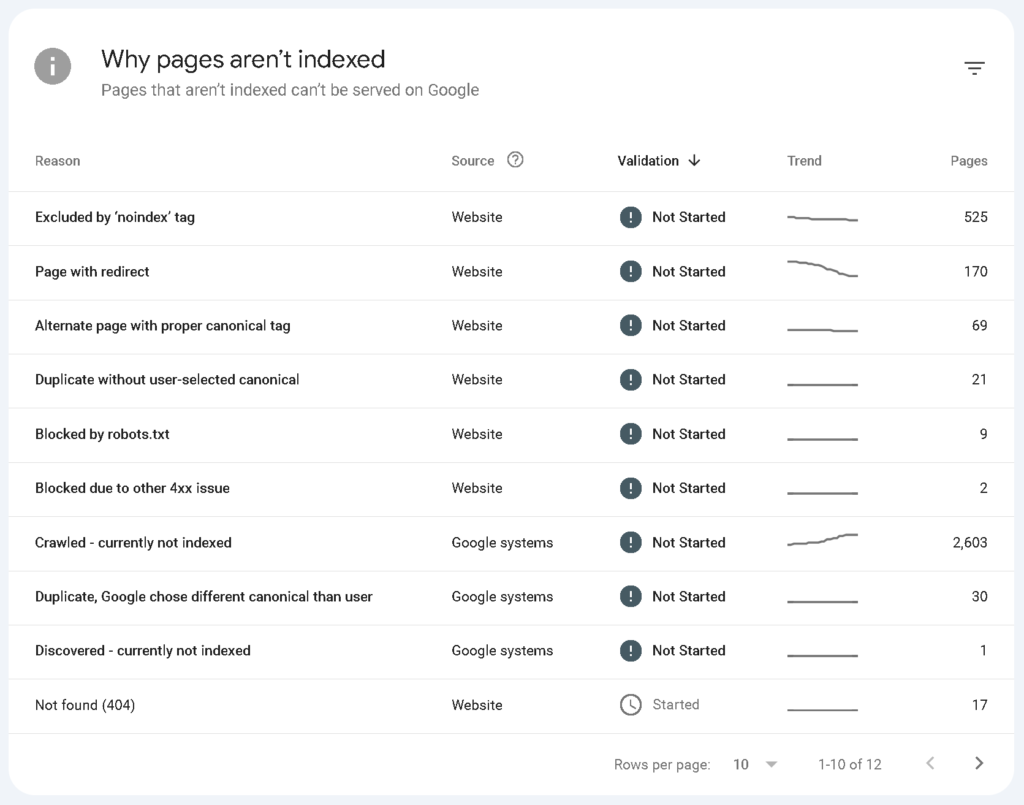
- Hunt for indexation gaps. Flag any conversion page showing “Crawled – currently not indexed” or “Discovered – not indexed.” That status usually signals a rendering or quality issue. On a BoFu page, it’s a direct pipeline leak.
- Protect your crawl budget. SaaS sites spin up huge numbers of low-value URLs from filters, dashboards, and parameters. Identify that crawl waste and rein it in, so Google spends its limited attention on the pages that earn revenue.
JavaScript rendering
Many SaaS sites run on React or Vue, and that creates a specific risk. If key content only appears after JavaScript executes, AI crawlers (which largely don’t render JavaScript reliably) may see a blank page where your value proposition should be. Googlebot renders JavaScript too, but with a delay that can slow indexation.
Run two quick tests. First, compare a page’s raw HTML against its rendered DOM; if they differ wildly, you have a rendering dependency. Second, load a key page with JavaScript disabled and check that the core content still appears. Where it doesn’t, push for server-side rendering or static generation on every revenue-influencing page.
Site speed and Core Web Vitals
Treat Core Web Vitals as a genuine audit pillar, not a closing afterthought. Largest Contentful Paint, Interaction to Next Paint, and Cumulative Layout Shift are confirmed ranking signals, and they shape conversion too. A sluggish demo page may cost you signups.
Audit the field data in Search Console and CrUX rather than relying on one-off lab scores. On SaaS sites, the usual culprits are heavy third-party scripts, unoptimized images, and render-blocking JavaScript. Each one is fixable.
Site architecture, HTTPS, and mobile
Finally, sweep the structural basics that quietly drain authority:
- Keep architecture flat. Important pages should sit within three clicks of the homepage. Hunt for orphan pages and redirect chains. Both waste crawl budget and bury the pages you most want to rank.
- Confirm HTTPS and canonicals. Check that HTTPS is enforced everywhere and that canonical tags are correct, which matters most when URL parameters generate near-duplicate pages.
- Verify mobile parity. Under mobile-first indexing, the mobile version is the version Google judges. Make sure it carries the same content and links as desktop.
Now, with crawlers able to reach and render your pages, the next question is whether those pages target the right things in the first place.
3. On-Page and Keyword Audit: Are You Targeting Revenue Intent?
Now that search engines can reach your pages, you need to know whether those pages aim at the right targets. An on-page and keyword audit isn’t only about whether a page is “optimized.” It’s about whether the page targets intent that actually leads to pipeline. Plenty of well-optimized SaaS pages rank for terms that will never produce a demo.
Audit keyword-to-page mapping and intent
This is where the most common B2B SaaS failure hides. A content audit of 40-plus B2B software sites found that over 70% of their content targeted purely informational keywords with little conversion potential. Meanwhile, commercial-intent terms, which convert far more reliably, sat under-served.
To find that imbalance on your own site, map every ranking page to a keyword and a funnel stage:
- Pull ranking keywords from SEMrush and Search Console, then tag each page by intent i.e., informational, commercial-investigation, or transactional.
- Identify the BoFu and MoFu pages you’re missing entirely: “[competitor] alternatives,” “X vs Y,” integration pages, use-case pages, and pricing. Buyers search these, and AI engines lean on them heavily.
If your keyword foundation feels shaky, fix that before going deeper. A structured approach to SaaS keyword research keeps every later step pointed at terms that convert.
Find and resolve keyword cannibalization
Keyword cannibalization happens when several of your pages compete for the same query. Instead of one strong page, you have three weak ones, splitting authority and leaving Google unsure which to rank. It’s one of the most common issues we’ve come across i.e., websites that have published overlapping content pieces over several years.
To spot it, open the Search Console performance report, filter by a query, and check how many of your URLs receive impressions for it. When several do, you’ve found cannibalization. You then have three fixes: consolidate the pages into one definitive piece, differentiate them so each targets a distinct angle, or redirect the weaker ones into the strongest.
Audit on-page elements
With intent and cannibalization handled, work through the on-page fundamentals on your priority pages:
| Element | What good looks like | Common SaaS mistake |
|---|---|---|
| Title & meta | Unique, intent-matched, keyword-bearing; BoFu titles written to earn the click | Templated titles duplicated across dozens of pages |
| Heading structure | One H1; logical H2s and H3s; question-form headings where natural | Multiple H1s, or headings stuffed with keywords |
| Internal linking | High-traffic ToFu pages link down to MoFu and BoFu pages | Top posts that dead-end with no next step |
| Schema markup | Article, FAQPage, Product or SoftwareApplication, Breadcrumb | No structured data at all |
Pay particular attention to internal linking. When your highest-traffic educational posts don’t route readers toward evaluation and conversion pages, pipeline leaks silently, and no amount of extra traffic fixes it. With on-page targeting sorted, step back and judge the content itself.
4. Content Audit: Does Every Page Earn Its Place?
ASaaS content audit evaluates how each page contributes to pipeline and then assigns every page one of four actions: keep, update, consolidate, or remove. The old instinct to keep everything works against you. Thin, outdated, and off-target pages dilute your topical authority and waste crawl budget. A content audit is a strategic reset, not a tidy-up.
Build a content inventory
Start with a complete inventory. List every indexable URL alongside its funnel stage, target keyword, organic traffic, conversions or assisted conversions, rankings, backlinks, and last-updated date. That single spreadsheet becomes the backbone of the whole audit.
Set realistic expectations on effort. For a blog of 50 to 100 posts, budget two to three focused days to build the inventory, pull the data, and reach a decision on each page. It’s real work, but it’s the work that tells you where to invest next.
Score each page on performance and ICP fit
Judge every page through two lenses. The first is performance: does the page win traffic, and does it contribute to conversions? The second is strategic fit: does it speak to your actual ideal customer profile and a real buyer question?
Both lenses matter, because a high-traffic page that attracts the wrong audience isn’t a win. It’s a distraction that flatters your dashboards while doing nothing for pipeline. A page that draws fewer visitors but consistently assists demo requests is worth far more.
Apply the four-action decision framework
With each page scored, assign it one of four actions. This framework turns a vague audit into a concrete to-do list:
| Action | When to use it | What it looks like in practice |
|---|---|---|
| Keep | Strong performer, on-ICP, accurate | Leave it alone; re-check at the next audit |
| Update | Decaying traffic, outdated info, or a page-2 ranker gone stale 12–18 months | Refresh the content, re-optimize, update the date |
| Consolidate | Several thin or overlapping posts on one topic | Merge into one strong page; redirect the rest |
| Remove | No traffic, no links, off-ICP, no path to value | Prune it; redirect or return a 410 |
Finally, pressure-test the quality of the pages you’re keeping and updating:
- Freshness. AI crawlers and Google both reward recency. Flag anything that hasn’t been meaningfully updated in 12 months or more.
- E-E-A-T. Look for real author bios, demonstrable expertise, original data, and genuine first-hand product insight. These signals increasingly drive both Google rankings and AI citations.
- Content gaps. Identify the clusters and buyer questions competitors cover that you don’t. Most of an audit’s value comes from gaps across the strategy, not from individual page tweaks.
A clean, well-targeted content library positions you for the channel most SaaS audits still ignore entirely — AI search.
5. AI Search Visibility Audit (AEO / GEO)
An AI search visibility audit checks whether AI answer engines (Google’s AI Overviews, ChatGPT, Perplexity, and Gemini) can reach, understand, and cite your site. Traditional SEO earns you a ranking. Answer engine optimization (AEO) and generative engine optimization (GEO) earn you a place inside the answer itself. They’re different goals, and they need their own audit.
Why AI search belongs in your audit
The case is straightforward. AI search traffic is growing far faster than traditional search, and AI-referred visitors tend to convert at a higher rate than the average organic visitor. Meanwhile, a large and rising share of searches now end without a click at all.
For B2B SaaS, that shift lands right where revenue is decided. AI engines increasingly shape commercial-investigation queries — “best X software,” “X vs Y for [use case]” — that sit directly above the demo and trial decision. When an AI assistant names a competitor and not you, you’ve lost the buyer before they ever reached your site.
Step 1: Audit AI crawler access
Begin with access, because nothing else matters if the crawlers can’t get in:
- Check your robots.txt for GPTBot, ClaudeBot, PerplexityBot, and Google-Extended. Confirm none are blocked. If they are blocked, this could be by a security plugin, or by an aggressive CDN bot filter.
- Confirm your revenue pages render server-side, since most AI crawlers don’t reliably execute JavaScript.
- Scan your server logs for AI bot user agents to see which pages they actually fetch.
Step 2: Test your citation footprint
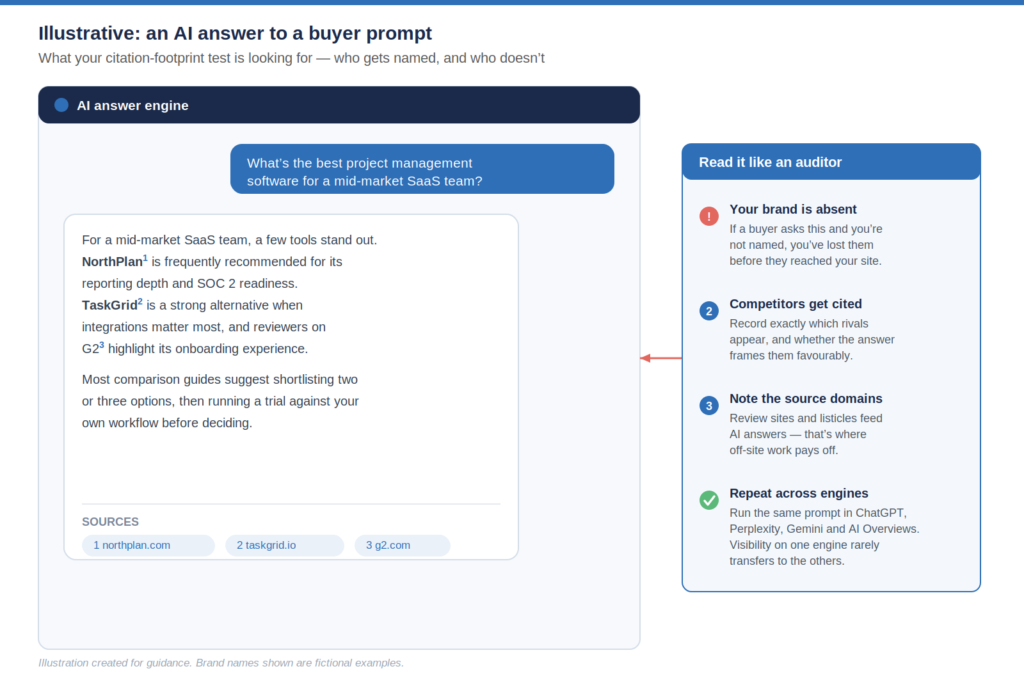
Next, find out where you already stand. Build a list of real buyer prompts spanning the funnel (category questions, comparison questions, and brand questions) then run each one across ChatGPT, Perplexity, Gemini, and AI Overviews.
For every prompt, record whether your brand appears, which competitors get cited, which source domains the answer pulls from, and whether the description of your product is accurate. Check breadth too: appearing on one engine rarely transfers to the others, so coverage across platforms is its own metric. Use a tracker like this:
| Prompt | Stage | ChatGPT | Perplexity | Gemini | AI Overviews | Competitors cited |
|---|---|---|---|---|---|---|
| “best [category] software” | BoFu | — | — | — | — | List rivals named |
| “[your brand] vs [rival]” | BoFu | — | — | — | — | Note who’s framed favorably |
| “how to [solve core problem]” | MoFu | — | — | — | — | Note source domains |
Step 3: Audit content for extractability
Then score your priority pages on the signals that make a language model quote them. “Citation readiness” comes down to a handful of concrete, checkable traits:
- Tables for comparisons. Structured data gets extracted far more reliably than the same facts buried in prose.
- Evidence. Statistics with named sources, expert quotes, and outbound citations all measurably lift AI visibility.
- Clarity and freshness. Favor definitive language over hedging, put key facts near the top, and show a current last-updated date.
Step 4: Audit off-site signals AI engines trust
Finally, look beyond your own domain. AI engines synthesize answers from across the web, so your off-site footprint shapes whether they trust and recommend you:
- Third-party listicles. Check whether your brand appears in the “best” and “top [category] software” round-ups that AI engines pull from, and note the ones you’re missing.
- Review platforms. Audit your presence and review volume on G2, Capterra, and similar sites, which AI tools frequently use as sources.
- UGC communities. See whether your brand comes up in relevant Reddit and forum threads that surface inside AI answers.
Many of those AI trust signals depend on the same thing traditional rankings do: authority. That’s the next audit.
6. Off-Page and Authority Audit
Off-page SEO covers everything beyond your own site that shapes how search engines and AI tools judge your credibility. An off-page audit measures that authority — and finds the gaps you can realistically close. Keep this section tight and focused; authority matters, but it shouldn’t crowd out content and conversion work.
Audit the backlink profile
Start with your backlinks, and judge quality before quantity:
- Assess the quality and relevance of your referring domains. Links from trusted, on-topic sites carry the weight; a pile of low-quality links does little.
- Identify genuinely toxic or spammy links. Resist the urge to disavow reflexively. It’s usually warranted only after a manual action or a clear negative-SEO attack.
- Find broken backlinks pointing at dead URLs on your site, then reclaim that lost authority with redirects.
Run a competitive link gap analysis
Next, turn your competitors’ backlinks into a roadmap. Pick two or three competitors and run a link-intersect analysis. It surfaces domains that link to them but not to you: a ready-made outreach list.
Note the content types earning those links, too. If a competitor’s original research report attracts dozens of referring domains, that’s a clear signal about what kind of linkable asset to plan. Earning placements like these is exactly what a deliberate link building campaign is built to do.
Audit brand authority and entity signals
Finally, audit how clearly the web understands your brand as an entity. Consistent entity signals i.e., a clear, repeated description of who you are and what you do across your site and beyond help Google and AI engines alike trust and recommend you.
Check that your brand name and details stay consistent everywhere, that your About page carries Organization schema, and that unlinked brand mentions exist that you could convert into links. Each one strengthens the authority that both search channels reward.
Authority brings buyers to the door. The next audit checks whether the site actually turns them into revenue.
7. Conversion Path Audit: From Ranking to Revenue
A conversion path audit checks whether organic visitors actually become demos, trials, and sales conversations. Most SaaS SEO audits stop at rankings. This step is where an audit either proves its value or quietly fails to.
Find where qualified traffic leaks
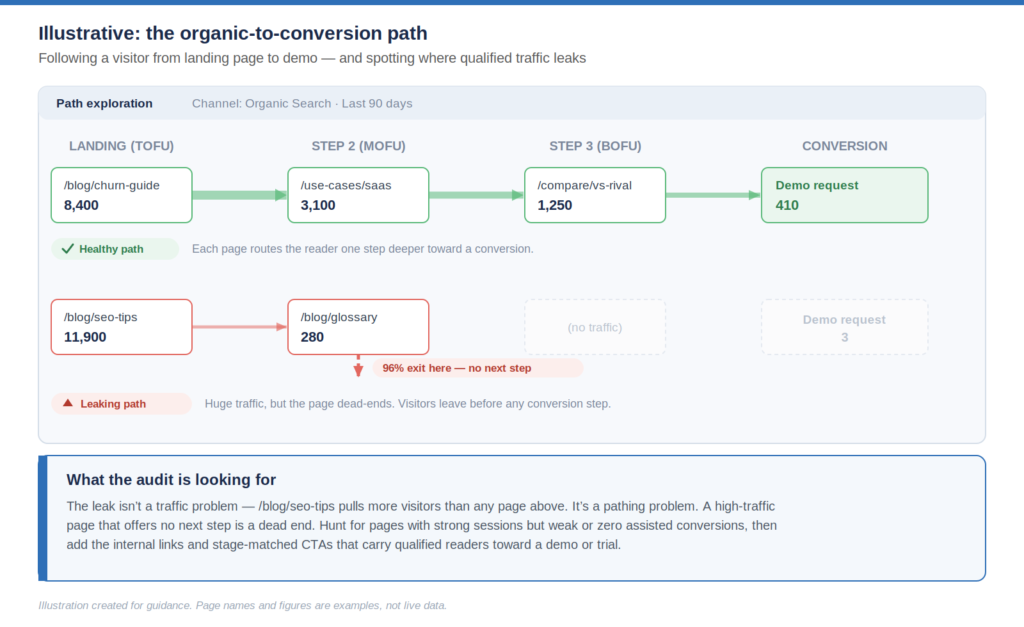
Open GA4 and follow the path from organic landing page to conversion. You’re hunting for a specific pattern: pages that pull strong traffic but contribute weak or no assisted conversions. Those are your leaks.
As you trace those paths, check three things:
- High-intent BoFu pages carry a single, clear primary CTA (book a demo, start a trial) visible above the fold and repeated naturally through the page.
- ToFu and MoFu pages offer a genuine next step. Do they guide the reader deeper toward a conversion page, or simply end?
- Forms and signup flows don’t add friction. Every extra field is a chance for a qualified buyer to abandon.
Audit CTA and conversion-page quality
Beyond the path, judge the conversion assets themselves. The most common mistake is a CTA mismatched to the buyer’s stage. For example, a ToFu reader who just learned a term isn’t ready for “book a demo,” so offer a lighter next step instead.
Then audit the high-intent pages closely. Demo and trial flows should feel fast and lead quickly to value. Conversion pages should carry real trust elements: customer logos, quantified case studies, and visible social proof. Seeing how other SaaS companies turned organic visibility into measurable demo and trial growth makes the gaps on your own pages easier to spot.
Note: deeper CRO comes later
Set expectations honestly here. Formal conversion rate optimization (structured hypothesis testing, heat-map tracking, and path exploration) is the natural next stage, not part of this first audit. It needs enough search traffic and conversion data to be meaningful, which typically arrives several months into a campaign.
For now, your conversion path audit should fix the obvious leaks: missing CTAs, dead-end pages, and high-friction forms. The systematic conversion rate optimization work follows once the data supports it.
Note: An audit that ends at rankings tells you whether you’re visible. An audit that includes conversion paths tells you whether that visibility pays. For B2B SaaS, only the second one connects organic search to a number your CFO cares about.
You’ve now audited your own site end to end. The last input is context — how you compare to the competitors winning the SERPs and the AI answers.
8. Competitor Benchmarking
Competitor benchmarking isn’t a separate audit. It’s a lens you apply across everything above. Your own metrics only mean so much in isolation. Benchmarking shows whether “flat traffic” means a stable market or a competitor steadily taking your share.
Benchmark across every dimension
Pick two or three real competitors i.e., the ones ranking for your priority terms and appearing in your AI prompts, which again may differ from your direct product rivals and compare across the dimensions you’ve already audited:
- Content and keyword gaps. Terms and clusters they rank for that you don’t.
- AI share of voice. Which competitors AI engines cite for your priority prompts.
- Authority gap. Referring-domain comparisons and the link-intersect list.
Capture it in a single snapshot so the gaps and opportunities are impossible to miss:
| Dimension | You | Competitor A | Competitor B | Gap / opportunity |
|---|---|---|---|---|
| Organic keywords | — | — | — | Clusters to build |
| Referring domains | — | — | — | Outreach targets |
| AI citations (priority prompts) | — | — | — | Prompts to win |
| BOFU page coverage | — | — | — | Comparison pages to add |
If a competitor consistently out-ranks and out-cites you, study the why. The answer usually points straight at your next priorities. With your own audit and this competitive context in hand, you can finally turn findings into action.
9. Turning the Audit Into a Prioritized Action Plan
An audit that ends as a document changes nothing. An audit that ends as a prioritized, owned backlog moves pipeline. This final step converts every finding from the sections above into a sequenced plan with owners, dates, and a way to measure success.
Prioritize by impact and effort
First, sort every finding into three buckets: quick wins, structural fixes, and ongoing programs. Then prioritize by revenue proximity. A fix to a BoFu conversion page outranks a cosmetic tweak to a ToFu post, every time.
Capture it all in one working document:
| Finding | Stage | Impact | Effort | Owner | Target date |
|---|---|---|---|---|---|
| BOFU page not indexed | BOFU | High | Low | — | — |
| Cannibalization on core term | MOFU | High | Medium | — | — |
| Thin posts to consolidate | TOFU | Medium | Medium | — | — |
Sequence the work
Next, order the work so each stage sets up the one after it. Fix critical technical and crawl blockers first. Then strengthen high-intent BOFU and MOFU content and conversion paths. After that, push on AI search optimization and authority building. Finally, settle into ongoing measurement.
Throughout, prioritize depth over breadth. A focused fix of ten high-intent pages will beat a light touch across a hundred. A short backlog you actually complete is worth more than a long one you don’t.
Measure against the baseline
Finally, prove the work landed. At 30, 60, and 90 days, re-check the baseline you captured in Section 1: rankings, organic traffic by funnel stage, demos and trials, indexed page count, and your AI citation footprint.
Then make the audit a habit, not an event. Run a full audit quarterly, with lighter monthly checks on Core Web Vitals, crawl errors, and AI citations. Search keeps shifting and your audit cadence should keep pace.
Turning Your Audit Into Pipeline
A modern SaaS SEO audit isn’t a rankings checklist. It’s a revenue diagnostic that runs across two search channels (traditional and AI) and follows the buyer all the way from the first impression to the signed deal. Technical health, on-page targeting, content quality, AI visibility, authority, and conversion paths aren’t separate audits. They’re one connected system, and a leak anywhere costs you pipeline.
The audit only pays off when its findings become a prioritized, owned plan tied to demos and trials. So be honest about the scale of it: a thorough review across all of these areas is a serious undertaking, and the highest-impact fixes usually need coordinated SEO, content, and CRO work rather than isolated tweaks.
If you’d like specialists to run that audit with you, you can book a consultative call with Platypus. We run revenue-aligned audits for growth-stage B2B SaaS companies, built to put your site in the best possible position to win qualified pipeline across Google and AI search alike.
Not ready to talk yet? Work through the steps above at your own pace, and lean on our wider guide to building a SaaS SEO strategy to turn your audit findings into a roadmap.
Related Posts
SaaS Keyword Research in 2026: Why Strategy Now Starts With the Buyer, Not the Term
Keyword research still matters, but it’s no longer the strategy. Here's how B2B SaaS teams should reframe keyword strategy around…

Dragan Veselinović
May 26, 2026
SEO Strategies for Google AI Mode: What Actually Works in 2026?
Generic SEO tactics won't cut it in Google AI Mode. Discover why brand positioning, awareness, and trust are the real…
Dragan Veselinović
Apr 8, 2026