

Your quarterly review lands and the SEO chart looks healthy. Organic traffic is up. Non-branded sessions are growing. The blog is publishing on schedule. Your CMO seems pleased.
Then you check the pipeline number. Demo requests from organic haven’t moved. Sales is closing the same handful of accounts they were closing twelve months ago. Marketing is producing more content than ever, and somehow none of it shows up in the deals your VP of Sales actually cares about.
If this scene feels familiar, the problem isn’t your execution. It’s your framing. And it’s worse in cybersecurity than in almost any other B2B SaaS category, because your buyers are the most risk-averse, the most peer-validated, and the most shortlist-driven buyers in the market. They decide whether you’re considered before they ever type a query.
This piece isn’t a how-to. You already know what SEO is. You don’t need another walkthrough of technical SEO basics or keyword research mechanics. What you need is a clear view of what changes when an SEO program is built around your GTM strategy, your buying committee, and the way security buyers actually research vendors. That’s what the next few minutes will cover: why generic SEO playbooks fail harder in cybersecurity, where the load-bearing strategic decisions sit, where pipeline actually forms in this category, and how to tell whether any of it is working.
Why generic SEO playbooks fail harder in cybersecurity
Most B2B SaaS SEO programs run a similar playbook. Build topical authority around category terms. Publish weekly. Optimise for traffic. It fails in most verticals, and we’ve covered why that happens in the broader B2B SaaS context. In cybersecurity, the same playbook fails faster, and the consequences are sharper. Three reasons matter.
The first is risk aversion. A CISO who picks the wrong vendor doesn’t just waste budget. They own a breach in front of the board, and increasingly they own personal liability under regulations like NIS2 and DORA. That risk profile translates directly into how buyers shortlist. They stick to vendors they already know, trust, and have seen validated by peers. Research from TrustRadius and 6sense shows that 78% of B2B buyers only consider vendors they’re already aware of, and that figure climbs to 86% for enterprise buyers, which describes the vast majority of cybersecurity deals. Earlier, Bain & Company research published in Harvard Business Review found that 90% of B2B buyers eventually choose a vendor from a shortlist they had in mind before formal research even began. If you aren’t on the shortlist before a buyer starts searching, you’ve already lost.
Second, the buying committee is larger and more fragmented than your SEO program is probably built for. A modern cybersecurity deal involves eight or more stakeholders: the CISO, a security architect, an IT director, a compliance lead, procurement, sometimes the CFO, sometimes legal. Each one has different concerns. Each one searches differently. A keyword strategy built around what the CISO Googles misses the security architect running the technical evaluation and the compliance lead writing the questionnaire, both of whom influence whether the deal closes.
Third, cybersecurity buyers self-educate further than buyers in almost any other category before they ever talk to sales. They read G2 and Gartner Peer Insights reviews. They lurk in r/cybersecurity and r/netsec. They subscribe to practitioner newsletters and follow specific voices on LinkedIn. They form preferences without filling out a form, and they arrive at the demo already 70–80% of the way through their decision. The traditional TOFU-to-BOFU funnel that most SEO programs are built around assumes the buyer lands on your website. In cybersecurity, the majority of the journey happens off your site entirely, on platforms your SEO program doesn’t own.
None of this is fixable with better technical SEO. It’s a strategy problem, and it needs a strategy answer.
Start from your GTM strategy, not your keyword list
The first input to a cybersecurity SEO program that actually moves pipeline isn’t a keyword research session. It’s a clear view of how your company goes to market. If you can’t answer the questions below in a single conversation, your SEO program is being built on sand, and no amount of execution downstream will fix that.
Before any keyword research starts, you need clarity on five things.
What sub-category are you in, precisely? Not “endpoint security”, but “cloud-delivered EDR for mid-market manufacturers running OT/IT converged environments.” Not “vulnerability management”, but “vulnerability prioritisation for security teams managing 50,000+ assets across hybrid infrastructure.” The strictness of how you define your niche predicts how easy or hard everything downstream becomes.
Who is your buying committee, role by role? Naming the CISO isn’t enough. The security architect running the technical evaluation, the compliance lead writing the SOC 2 or NIS2 questionnaire, and the procurement contact running vendor risk assessment all search differently and need different content. Each one needs to find what they’re looking for, or the deal stalls in their hands.
What’s your ACV and sales cycle length? A $30K ACV self-serve product with a 30-day cycle rewards comparison pages, integration content, and material that accelerates trial activation. A $250K ACV enterprise platform with a nine-month cycle rewards strategic POV pieces, framework-aligned content, and material that arms an internal champion to sell the decision through procurement. Same SEO discipline, completely different content set.
What triggers a buyer to enter your market? In cybersecurity, it’s almost always one of three things: a compliance deadline, a recent incident (their own or a peer’s), or a budget cycle. Each trigger produces different search behaviour. Compliance-triggered searches are time-bound and specific e.g., “NIS2 vulnerability management requirements,” “DORA third-party risk evidence.” Incident-triggered searches are urgent and emotional. Budget-cycle searches are comparison-heavy. Your content has to meet each one where it forms.
Is your motion product-led, sales-led, or hybrid? This determines what role your content plays. PLG products use SEO to drive sign-ups directly. Sales-led products use SEO to seed shortlists months ahead of any direct outreach.
The cost of skipping this work is predictable. A keyword-first program produces a blog full of “what is zero trust” articles ranking for queries no in-market buyer is using. A GTM-first program produces a smaller, sharper set of pages aligned to the buyers, triggers, and sub-category you actually sell into. The first program looks busy. The second one produces pipeline.
Strict positioning is the load-bearing decision
You can do everything else well and still fail if your positioning is generic. In a category as crowded as cybersecurity, this is the single decision that determines whether SEO can work for you at all.
The forces driving this are getting stronger, not weaker. Search queries are longer than they used to be. The six and seven-word queries that used to qualify as long-tail are now the entry point, with buyers building context across multi-step sessions and full-sentence prompts inside ChatGPT, Perplexity, and Google AI Mode. We’ve covered the broader implications of this AI search shift elsewhere. The cybersecurity-specific takeaway is that vague positioning gets surfaced vaguely or not at all. LLMs cite brands that are consistently described the same way across the brand’s own site, their reviews, and the third-party listicles that mention them. A brand with fuzzy positioning gets summarised generically. Often, it doesn’t get cited.
Consider the difference in practice. “Penetration testing software” is a category. “Automated penetration testing for SaaS companies preparing for SOC 2 Type II” is a position. The first competes against every PTaaS vendor on the planet for keywords most of your real buyers aren’t using. The second narrows the addressable buyer set, surfaces a tighter set of long-tail queries you can realistically rank for, and gives your sales team a story their prospects already pre-qualified themselves into.
The same logic applies across cybersecurity sub-categories. “Cloud security posture management” is a category; “CSPM for fintech engineering teams running multi-account AWS environments under PCI DSS” is a position. “Identity and access management” is a category; “non-human identity security for organisations running large agentic AI deployments” is a position. Strict positioning narrows your audience, sharpens your keyword set, gives AI search interfaces something specific to remember you by, and makes every page on your site work harder.
Positioning doesn’t live in your SEO program. It lives upstream of it, and it determines whether everything downstream (your keyword set, your content plan, your link building, your AI search visibility) has a real shot at producing pipeline. If you’re not part of the positioning conversation in your company, your SEO will rank for the wrong terms and bounce.
Map your content to the buying committee, not the marketing funnel
Most cybersecurity content programs are still built around marketing funnel stages i.e., TOFU at the top, MOFU in the middle, BOFU at the bottom. A revenue-aligned program is built around the buying committee, because in cybersecurity, the same deal involves multiple people who are all in different stages simultaneously. The CISO might still be in problem-aware mode while your security architect is already comparing three vendors in a sandbox. Both of them need to find what they need on your site, or the deal slows.
Four roles deserve specific content attention.
Your CISO or Head of Security is looking for category-level credibility. Strategic perspective, peer validation, and material that helps them justify the spend internally. Executive briefings, named-customer case studies, and POV pieces that take a clear position on industry direction work here. Generic “what is” articles don’t.
Your security architect is running the technical evaluation. They want integration depth, deployment realities, and direct technical comparisons. Solution architecture deep-dives, integration documentation, and “X vs Y” pages with real technical detail do the job. Marketing-glossed feature pages fail this audience instantly.
Your compliance and GRC lead is driving the security questionnaire. They want framework-specific guidance and audit-friendly documentation. Content mapped to SOC 2, ISO 27001, NIS2, DORA, HIPAA, and PCI DSS (whatever applies to your buyers) is what gets you past their stage. The questionnaires themselves are getting more demanding: the NCSC’s guidance on supply chain cyber security has become the de facto reference for how UK and many EU enterprise buyers structure vendor risk reviews, and your trust-center content needs to anticipate it. The UK government’s Cyber Security Breaches Survey 2025/2026 found that 43% of UK businesses and 70% of medium-sized businesses reported at least one breach or attack in the past year, which is why compliance and supply chain risk reviews are now standard in any serious procurement process.
Your procurement contact gates the contract. They want pricing transparency, references, and vendor-risk documentation. Pricing pages, customer reference programs, and trust-center pages with current certifications are the assets that move them.
The structural takeaway is simple. A cybersecurity SEO program that writes only for the CISO loses deals at technical validation and procurement. The MOFU and BOFU content on most cybersecurity sites is thin and CISO-aimed. Filling out the rest of the committee’s content needs is where most programs find their fastest pipeline gains.
One more priority correction worth naming. Most cybersecurity SEO programs treat competitor-alternative and category-versus-category keywords as a phase-two priority i.e., something to get to after the educational content is built out. That’s the wrong order. Queries like “[competitor] alternatives,” “[solution] vs [solution],” “[category] for [vertical or compliance framework],” and “[category] pricing” convert at multiples of educational content. A buyer searching “best PTaaS for SOC 2 Type II” is in-market. A buyer searching “what is penetration testing” is not. Build the commercial set first. Build the educational set around it once the commercial set is producing pipeline.
Most of the buying journey doesn’t happen on your website
If you accept the premise that cybersecurity buyers spend more of their research time off-site than on, then your SEO budget allocation needs to follow that reality. Most don’t. Most cybersecurity programs spend 90% of their effort on the company’s own blog and 10% on everything else. The allocation is inverted relative to where buying decisions actually form.
Where your buyers spend their research time matters more than where you’d prefer them to spend it. Five surfaces consistently come up in our work with cybersecurity clients.
G2, Gartner Peer Insights, TrustRadius, and Capterra are the de facto validation layer for cybersecurity software. Review density and recency directly influence both buyer perception and AI search citation. If your reviews are thin or outdated, you’re losing deals you’ll never see. Most cybersecurity vendors underinvest here.
Industry listicles e.g, “top X PTaaS platforms 2026,” “best CSPM tools for fintech,” “leading SOAR vendors for mid-market” are the first-result pages for category-level queries in both classic search and AI Overviews. Brand presence on these listicles compounds and is achievable through a defined outreach process, not luck. If you’re not on the listicles your buyers consult, you don’t exist in their consideration set.
Reddit communities matter more in cybersecurity than in most B2B categories. r/cybersecurity, r/netsec, r/sysadmin, r/blueteamsec are read by practitioners, and the moderation is technical enough that recommendations carry real weight. AI search interfaces increasingly cite Reddit threads directly, which means presence in these communities is now a dual SEO and AEO play.
Practitioner newsletters and independent media such as Risky Business, Dark Reading, The Cyberwire, CISO-focused Substacks, and similar function as both backlink sources and AI-citation surfaces. Earned mentions here compound over time.
Analyst coverage from Gartner, Forrester, and IDC still matters, even outside the formal Magic Quadrant or Wave process. Mentions in their commentary and briefing notes feed both buyer perception and LLM training data.
The work here is harder, slower, and less measurable than on-site content, which is exactly why most programs underinvest in it. Brand mentions across these surfaces are now what determines whether you appear in AI-generated answers. The infrastructure overlap between “where cybersecurity buyers go to research” and “what LLMs cite when answering cybersecurity questions” is convenient. Most cybersecurity SEO programs are underinvested in both at once.
Measure pipeline, not pages
Cybersecurity has the same measurement failure mode as the rest of B2B SaaS, with one extra complication: the dark funnel is bigger here. Buyers research anonymously for months across review sites, Reddit, and peer communities before ever touching your site. Last-click attribution will systematically understate how much organic is contributing. If you measure your SEO program the way most teams do, you’ll undervalue it by a meaningful margin and you’ll cut the wrong things first.
There are two distinctions worth holding onto.
Diagnostic metrics tell you whether the mechanics are working. Rankings, organic traffic, domain authority, indexation health etc., are the oil temperature and tyre pressure of your SEO program. They aren’t the lap time. Primary metrics such as pipeline from organic, SQLs attributed to organic, organic-influenced ARR, payback period etc., are what the program is for. A program that moves diagnostics without moving primaries is pointed at the wrong demand.
Attributed pipeline and influenced pipeline are different numbers. In cybersecurity especially, last-click misses most of what organic does. The cheapest and most underused fix is an open-text field on your demo form: “How did you first hear about us?” Leave it open, not a dropdown. The answers consistently surface channels and content your dashboard never saw. Most companies we work with discover their organic program is influencing 30–50% more pipeline than attribution gives it credit for, once they start asking.
One cybersecurity-specific point on timelines worth stating directly. Sales cycles in this category routinely run six to twelve months for mid-market and nine to eighteen months for enterprise. Pipeline signal from a well-built SEO program shows up in three to six months. Closed revenue lags substantially behind that. Any program (internal or agency) promising attributable revenue from cybersecurity SEO inside a single quarter is misreading the category. Set the expectation with your leadership team accordingly, or you’ll find yourself defending a program before it’s had time to work.
SEO is part of a system, especially here
Your buyer doesn’t experience SEO, AI search, content marketing, and CRO as four channels. They experience your brand. A successful cybersecurity SEO program operates as part of an integrated organic system, not as a standalone discipline.
The compounding works in a specific way. A prospect reads your comparison article. They see you in a “top X” listicle a week later. They notice a thread mentioning you on r/cybersecurity. They read two recent G2 reviews. They land on your site, see clear pricing, a current SOC 2 page in the trust center, and a named case study from a company that looks like theirs. Then they book a demo. Attribution credits the last touch. The job was actually done by the whole system. Remove any one of those components and the chain breaks. Brands that get this right open a structural cost-of-acquisition advantage over competitors still running SEO as a standalone traffic channel and in a funding environment where CAC efficiency is being scrutinised at every board meeting, that advantage isn’t marginal.
This is the lens we apply across every cybersecurity engagement at Platypus. Organic search, AI search, content, and CRO operated as one program, aligned to a shared pipeline target. If you want to see how that looks in practice, our work with cybersecurity SaaS clients is where that approach lives.
What to do with this
Cybersecurity SEO isn’t a content production problem. It isn’t a technical SEO problem either. It’s a framing problem, and the fix is upstream of any tactical change you can make.
Programs built around traffic produce traffic. Programs built around your GTM strategy, your buying committee, your buyer’s real research behaviour, and a strict positioning produce pipeline. The difference between the two looks small on paper and shows up substantially in the quarterly numbers, especially in this category, where buyers are more risk-averse, the buying committee is larger, the dark funnel is deeper, and the AI search shift is moving fastest in exactly the places your buyers already trust.
If your current SEO program is producing traffic but not pipeline, you don’t need a different agency or a better keyword list. You need a different starting point. The brands that work that out this year will spend the next two compounding ahead of the ones that don’t.If you’d like to talk through what a revenue-aligned organic program looks like for your specific cybersecurity sub-category, we’d be happy to walk you through it.
Related Posts
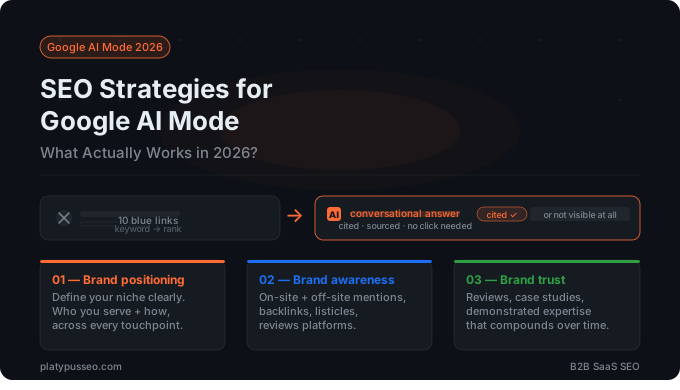
SEO Strategies for Google AI Mode: What Actually Works in 2026?
Generic SEO tactics won't cut it in Google AI Mode. Discover why brand positioning, awareness, and trust are the real…

Dragan Veselinović
Apr 8, 2026
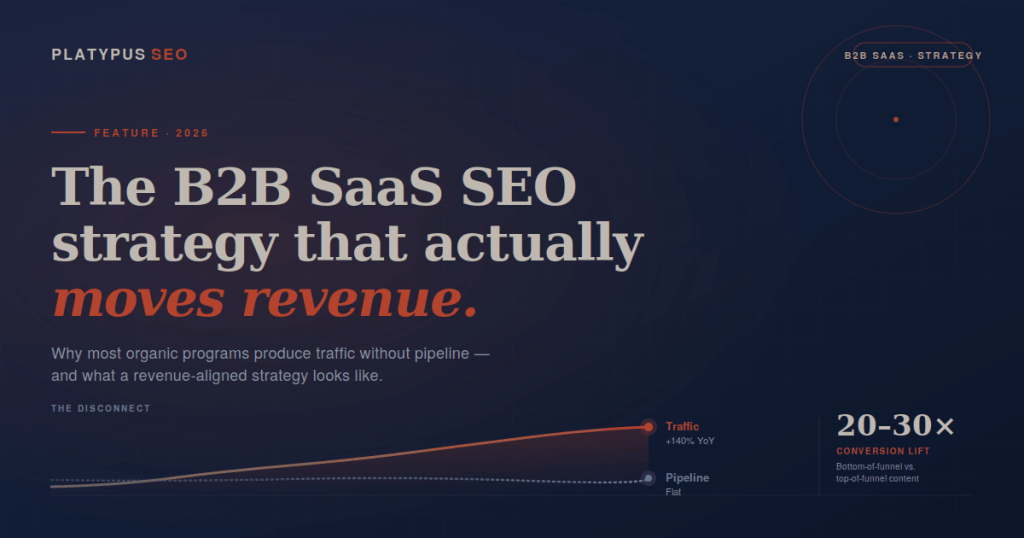
The B2B SaaS SEO Strategy That Actually Moves Revenue
Every quarter, the same report lands on the CEO’s desk. Organic traffic is up 140 percent year over year. Non-branded…
Dragan Veselinović
Apr 20, 2026