

Cybersecurity is one of the most saturated and technically demanding categories in B2B SaaS. Gartner tracks thousands of vendors across security subcategories, and your prospective buyers routinely conduct extensive self-education before they ever talk to a sales rep. If your organic search presence doesn’t hold up to that scrutiny, you’re out of the running before the conversation starts.
You’re probably already aware that organic search drives the bulk of pipeline for security vendors. What’s changed in 2026 is that ranking on Google alone no longer cuts it. CISOs, security architects, and procurement teams now research vendors through ChatGPT, Perplexity, Gemini, and Google AI Mode just as often as they use traditional search. If you’re not cited in those answers, you’re invisible. And being the most leveraged acquisition channel in B2B SaaS suddenly demands a much broader playbook.
That’s where the agency you choose matters. Not every SEO partner understands cybersecurity. The category punishes vague claims, FUD-laden copy, and AI-generated fluff faster than almost any other B2B audience. You need a team that knows the difference between EDR and XDR without Googling it, understands how analyst coverage shapes buyer journeys, and can build authority that holds up to CISO scrutiny.
This guide walks you through the 10 best agencies positioned to help cybersecurity companies grow organic pipeline in 2026. You’ll find what each does well, who they suit, and how to think about choosing the right fit for where your company sits today.
How we evaluated these agencies
Before getting into the list itself, it’s worth being explicit about how we picked these agencies. A list with no criteria is just a directory. If you’re making a real decision, you deserve to see the workings.
We weighted seven factors when assessing fit for cybersecurity B2B SaaS:
- Cybersecurity category expertise: demonstrated work in cybersecurity, infosec, or adjacent technical and regulated categories like fintech, compliance, and devops.
- Revenue alignment: whether they optimize for pipeline, demos, and trials rather than traffic and ranking vanity metrics.
- AI search readiness: an explicit methodology for GEO and AEO, not just traditional SEO with AI bolted on.
- Content depth and credibility: can they produce content that a security architect won’t roll their eyes at?
- Link building standards: placement relevance and publication quality, not just DR scores.
- Reporting and accountability: whether their dashboards tie back to commercial outcomes a CFO would recognize.
- Engagement model: embedded partner vs. traditional agency, senior involvement, communication cadence.
One important note before you start scanning: the list isn’t strictly ranked one to ten. Each agency has a different sweet spot, and the right choice depends heavily on where your company sits in its growth journey. A Series A ZTNA startup needs something fundamentally different from a Series C SIEM platform, so read with your own context in mind.
Our Pick: the 10 best cybersecurity SEO agencies in 2026
Below, you’ll find each agency assessed using the same structure: positioning, overview, key strengths, who they’re best suited for, and where you’ll want to think carefully before signing on. Let’s get into it.
1. Platypus SEO
Best for: Growth-stage cybersecurity SaaS companies ($5M+ ARR, Series A or B) selling mid-market or enterprise, where organic search functions as a strategic channel.
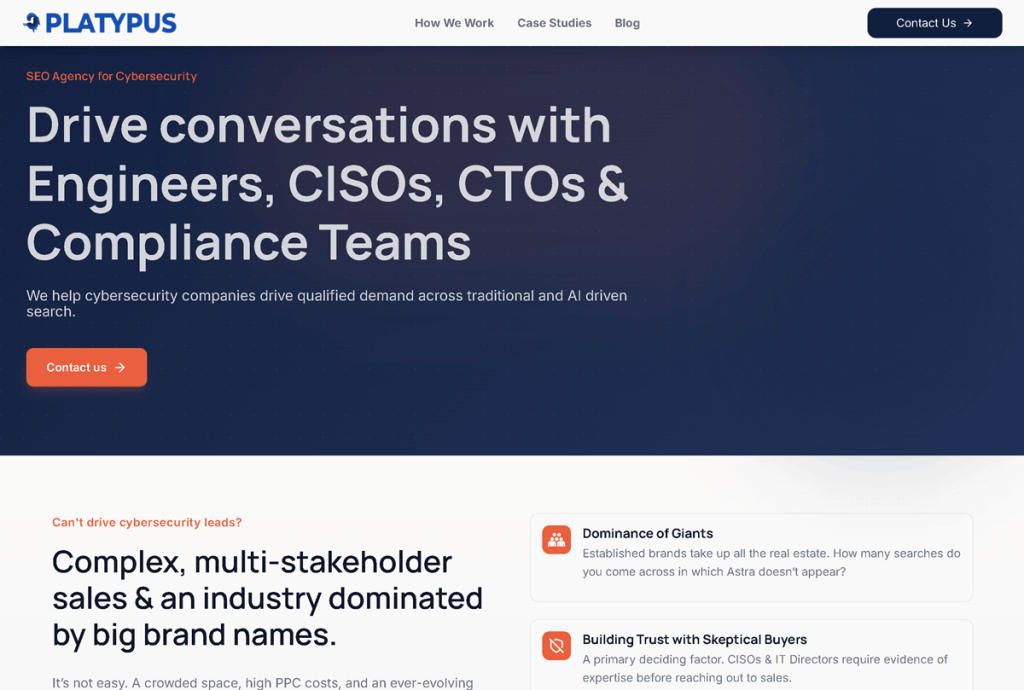
Platypus is a specialist organic growth agency built exclusively for European B2B SaaS (including cybersecurity vendors) that ties SEO and AI search to pipeline rather than traffic. They operate with a revenue-first mindset, which means every keyword, every content asset, and every link secured connects back to your sales funnel.
Cybersecurity sits squarely in their wheelhouse because the category demands what they already do well: technical credibility, long-form authority content, and an integrated approach to traditional search and AI search from day one. As a dedicated b2b cybersecurity SEO agency, they treat their engagement as an extension of your internal marketing team and not as an account to service.
Where Platypus stands apart is the integration of SEO, AEO, and GEO into a single coordinated motion. Most agencies still treat AI search as an afterthought. From the first month, they’re building the brand mentions, review platform coverage, and authority signals that get you cited when a CISO asks ChatGPT for the top vendors in your category. That matters because AI-driven search now shapes a meaningful share of B2B vendor discovery, and the gap between vendors who show up there and those who don’t will only widen.
Key strengths
- Revenue-aligned methodology with reporting that ties to pipeline, demos, and ARR
- Integrated SEO + AEO + GEO from day one
- Embedded-partner engagement model with senior strategic ownership
- European B2B SaaS specialization with deep familiarity in technical, regulated categories
2. First Page Sage
Best for: Enterprise cybersecurity vendors with substantial budgets, longer sales cycles, and CISO-targeted buyer journeys.
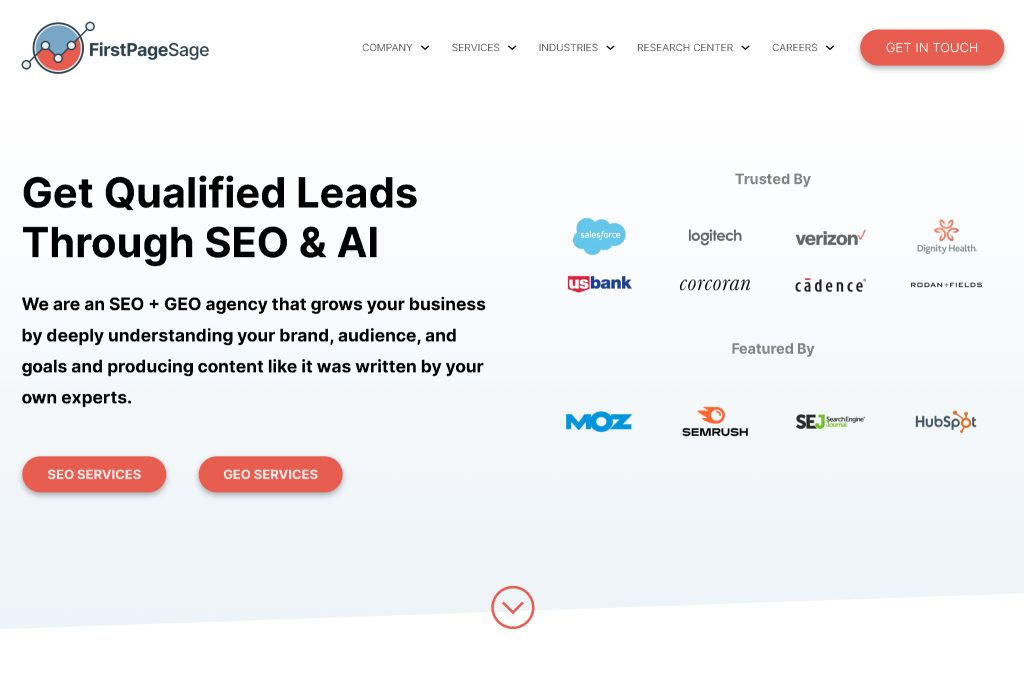
First Page Sage is a long-established US-based agency with one of the deepest cybersecurity track records in the SEO industry.
They’ve built a reputation around thought-leadership SEO i.e., long-form, analyst-style content engineered to win enterprise buyer trust. Their cybersecurity portfolio spans large security vendors and managed service providers, and they tend to perform especially well for companies targeting CISOs with longer sales cycles.
Key strengths
- Deep cybersecurity portfolio with enterprise-tier client base
- Thought-leadership SEO methodology designed for high-ticket B2B
- Strong content quality calibrated for analyst-influenced buyer journeys
3. Single Grain
Best for: Cybersecurity vendors that want consolidated growth marketing across multiple channels with one partner, and have the budget to fund that broader scope.
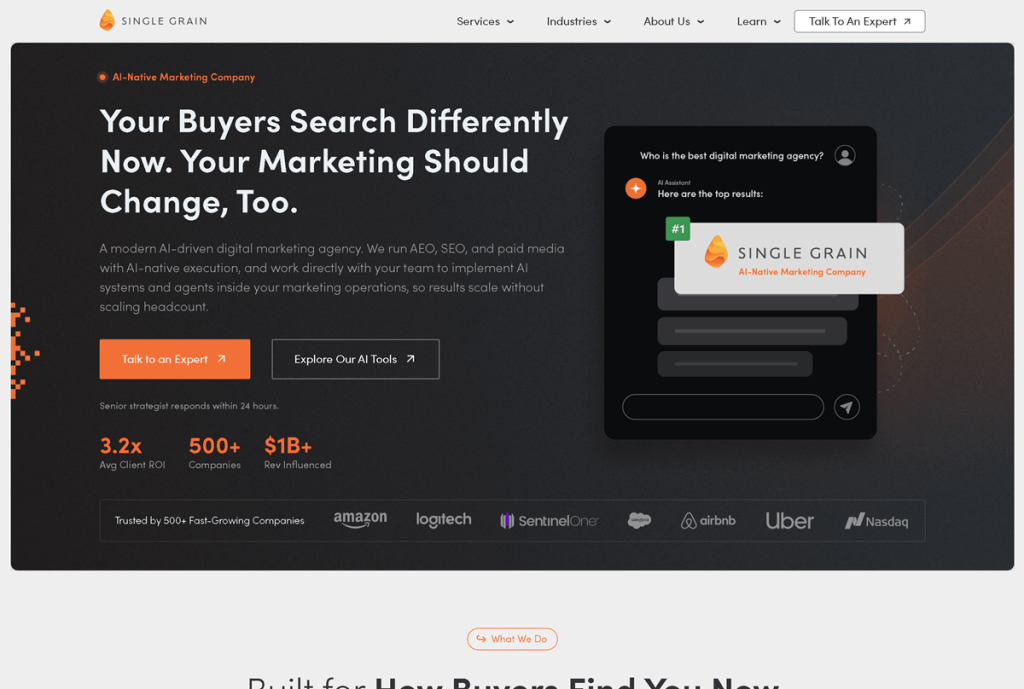
Single Grain is a broad B2B and tech-focused agency that handles SEO alongside paid acquisition, content, and conversion optimization.
Founder Eric Siu’s personal brand and podcast network give Single Grain unusual distribution reach for an agency of its size, which translates into faster content amplification for clients. They’ve worked with cybersecurity companies as part of a wider tech client base, and they suit teams that want SEO embedded into a broader growth marketing program rather than as a standalone service.
Key strengths
- Multi-channel growth marketing under one roof (SEO, paid, content, CRO)
- Strong content amplification through founder-led distribution channels
- Data-driven approach with documented experimentation processes
4. NoGood
Best for: Cybersecurity startups looking for SEO as part of a broader growth marketing operating model, with appetite for fast iteration and channel testing.
NoGood is a growth marketing agency that’s expanded aggressively into SEO and content for tech and SaaS clients.
Their pedigree sits in performance marketing (they came up running paid acquisition for high-growth startups) and that mindset carries through to their SEO work. They’re data-led, experimentation-friendly, and increasingly AI-forward in their methodology, which makes them a credible option for cybersecurity startups that want SEO embedded into a broader growth function.
Key strengths
- Performance marketing DNA applied to organic channels
- Strong experimentation culture and measurement discipline
- AI-forward approach to content production and search optimization
5. Skale
Best for: B2B SaaS companies (cybersecurity included) looking for productized SEO with reliable execution and a structured delivery model.
Skale is a London-based B2B SaaS-focused SEO agency with a productized, pod-based delivery model.
Their approach is heavily structured: they assign cross-functional pods to each client, with defined responsibilities for strategy, content, technical SEO, and link building. That structure produces predictable execution, which appeals to marketing leaders who’ve been burned by less reliable agency partners. Their B2B SaaS portfolio includes a handful of cybersecurity and adjacent technical clients.
Key strengths
- B2B SaaS specialization with consistent methodology
- Pod-based delivery for predictable output
- Programmatic SEO experience for SaaS use cases
6. Omniscient Digital
Best for: Cybersecurity vendors heavily invested in content-led growth, with marketing teams that value editorial depth over content volume.
Omniscient Digital is a B2B content marketing agency with a strong SEO discipline and a reputation for editorial-grade output.
Their model centers on narrative-driven content strategy. They think more like an in-house content team than a traditional agency. That suits cybersecurity vendors investing in thought leadership and content-led growth, particularly those with mid-market or enterprise sales motions where content quality drives qualified pipeline.
Key strengths
- Editorial-grade content quality with strong narrative discipline
- Mid-market and enterprise SaaS focus
- Strategic content planning aligned to buyer journeys
7. Animalz
Best for: Cybersecurity vendors with developed brand voice and content strategy who need scaled, high-quality editorial production.
Animalz is one of the best-known content marketing agencies in B2B SaaS, with an editorial reputation that few competitors can match.
Their writer roster runs deep, and the content they produce reads like the best in-house teams in tech. For cybersecurity vendors with established brand voice and a content-heavy growth strategy, they can extend editorial output without diluting quality.
Key strengths
- Industry-leading editorial quality
- Strong writer bench with domain-specific specialists
- Brand-aligned long-form content that performs in search
8. Directive
Best for: Mid-market and enterprise cybersecurity vendors that want full-funnel paid and organic integration under one strategic umbrella.
Directive is a performance marketing agency built around what they call a Customer Generation methodology; an integrated paid and organic acquisition tied to customer-fit modeling.
Their B2B SaaS focus is well established, and their integrated approach suits cybersecurity vendors that run substantial paid programs alongside SEO and want both managed coherently. They tend to do their best work with mid-market and enterprise security companies that have budget and analytical maturity to match their methodology.
Key strengths
- Integrated SEM and SEO operating model
- Customer-fit modeling tied to acquisition channels
- Strong B2B SaaS pedigree with mid-market and enterprise focus
9. Ten Speed
Best for: Cybersecurity vendors who want senior strategic attention at smaller engagement scale, and value transparency over a polished agency facade.
Ten Speed is a B2B SaaS SEO agency known for founder-led delivery and a deliberately small client roster.
Senior strategists run engagements directly rather than handing accounts to junior managers, which produces a different quality of thinking from what most agencies deliver. Their technical SEO depth is strong, and their methodology is unusually transparent for the industry.
Key strengths
- Founder and senior-led engagements rather than delegated account management
- Technical SEO depth and transparent methodology
- B2B SaaS specialization
10. Growth Plays
Best for: Cybersecurity vendors that need strategic positioning and narrative work before scaling SEO production, particularly in newer or contested categories.
Growth Plays is a B2B content strategy firm that combines positioning and narrative work with content production and demand strategy.
They’re a strong fit for cybersecurity vendors who haven’t yet nailed their category positioning or buyer narrative because trying to scale SEO production before that work is done usually wastes budget. Their engagements often start with positioning before moving into content execution.
Key strengths
- Positioning and narrative work alongside content production
- Demand strategy alignment with broader GTM motion
- Strong product-led growth and SaaS positioning background
What to look for in a cybersecurity SEO agency
Even with a shortlist in front of you, the right agency for your business depends on what you weight most heavily. Here’s what we’d push you to scrutinize when you’re evaluating partners.
Category fluency
Cybersecurity is technically dense, and the writers and strategists on your account need to discuss EDR versus XDR, zero trust versus SASE, or threat intel pipelines without needing constant correction. Ask for portfolio samples in your specific subcategory. If they can’t show you work in your space, expect the first six months to involve a lot of cleanup edits from your team.
You’re also testing for cultural fluency with security buyers. CISOs and security architects have a low tolerance for marketing fluff. The right agency writes the way your audience reads, which is to say: substantive, technical, and stripped of marketing-speak.
Revenue alignment over traffic targets
Cybersecurity buying cycles run long and involve analyst reports, peer reviews on G2 and Gartner Peer Insights, CISO community input, and committee approvals. Agencies optimizing purely for traffic miss the point entirely. Ask candidates directly: how do you measure pipeline contribution? How does your reporting tie back to ARR or pipeline-influenced metrics?
If the answer relies on rankings, sessions, and DR scores, you’re looking at a partner built for a different era of marketing i.e., one where the CFO didn’t need to be convinced that SEO was worth funding.
AI search and GEO readiness
This is the question most agencies still answer poorly. Security buyers increasingly use ChatGPT, Perplexity, and Google AI Mode for vendor research and category orientation. If your agency doesn’t have an explicit methodology for getting cited in AI answers, they’re working with last year’s playbook.
Ask candidates to walk you through their approach to Google AI Mode and AI Overviews specifically. If you want to see how the AI search agency landscape sits more broadly, our breakdown of the leading firms in this space covers it in detail.
Content that respects buyer intelligence
Security buyers reject thin or AI-generated content faster than any other B2B audience. They can spot a generic listicle padded with statistics-as-decoration within the first paragraph, and once that trust is broken, the entire content asset becomes worthless. Demand technically credible content with original analysis, not aggregated commentary.
Volume metrics are particularly dangerous in cybersecurity. Twenty pieces of mediocre content actively damages your authority more than two genuinely good pieces would build it. If an agency’s pitch leads with output velocity rather than quality, that’s a red flag.
Link building that won’t damage your brand
In cybersecurity, trust is the product. Low-quality link placements don’t just hurt your rankings. They can damage your reputation with the analysts and journalists you’re also trying to influence. Ask candidates about their placement standards, vetting process, and the publications they secure links from. The right answer involves named publications you’d actually want your brand associated with.
Watch for agencies that lead with link volume. In your category, ten links from genuinely relevant publications beat a hundred links from generic SaaS or marketing blogs.
Choosing the right cybersecurity SEO partner for your stage
Not every agency on this list suits every cybersecurity company. The right choice depends heavily on where you sit today. Here’s how we’d think about the segmentation.
Early-stage cybersecurity startups (pre-Series A, under $1M ARR)
At this stage, SEO is more about category positioning, founder-led content, and laying clean technical foundations than scaling content production. A specialized boutique partner or a senior consultant will usually outperform a full-service agency, because you don’t yet have the search demand or commercial data to fuel a larger engagement.
If you’re here, focus first on getting your positioning right and building a technical foundation that won’t need re-engineering later.
Growth-stage cybersecurity SaaS (Series A or B, $5M+ ARR)
This is the sweet spot for most agencies on this list. You need a partner who can deliver quick-win optimizations alongside a 12-month strategic roadmap, and who integrates with your internal marketing team rather than sitting at arm’s length. Embedded-partner engagement models almost always outperform traditional agency models at this stage, because the strategic decisions are too consequential to outsource to monthly reporting calls.
You should also expect your partner to bring AI search optimization into the engagement from day one. The vendors who lead their categories in 2027 will be the ones who started building AI search authority in 2026.
Enterprise cybersecurity vendors (Series C+, $25M+ ARR)
Enterprise security vendors need partners who can coordinate across product marketing, demand generation, analyst relations, and sometimes regional teams. The complexity demands enterprise-pedigreed agencies. First Page Sage and Directive both fit well here and the cost reflects that.
At this scale, the difference between agencies often comes down to who can manage the stakeholder map, not who can produce better content. Both are necessary, but the former is harder to find.
Cybersecurity SEO in 2026 is about pipeline, not pageviews
The cybersecurity category will only get more competitive in 2026 and beyond. New vendors enter weekly, incumbents consolidate, and buyer attention fragments across more channels than ever. The agencies that win for their clients in this environment treat organic search as a commercial system tied to pipeline, and not as a content factory that ships posts and hopes for traffic.
AI search has changed the rules in ways most agencies still haven’t internalized. Traditional SEO playbooks alone leave material pipeline on the table because visibility in ChatGPT, Perplexity, and Google AI Mode is now part of the same job, not a separate workstream. The agencies on this list who treat it that way will produce meaningfully different results from those who treat it as a bolt-on.
Whichever agency you choose, demand three things: revenue alignment, technical credibility, and an embedded-partner mindset. Anything less and you’re paying for activity, not outcomes.If you’re a European B2B cybersecurity SaaS company and you’d like to talk about whether Platypus is the right fit, reach out to our team. We’ll tell you honestly if we’re the right partner. And if we’re not, we’ll usually know who is.
Related Posts
10 Best MadX Digital Alternatives for SEO / AEO in 2026
Compare the 10 best MadX Digital alternatives in 2026, from B2B SaaS specialists to technical, ecommerce, and local search experts.

Dragan Veselinović
May 28, 2026
10 Best AI Search Optimization Agencies in 2026
This guide compares ten agencies with different strengths so you can find the right fit for your stage, resources, and…
Dragan Veselinović
May 6, 2026