
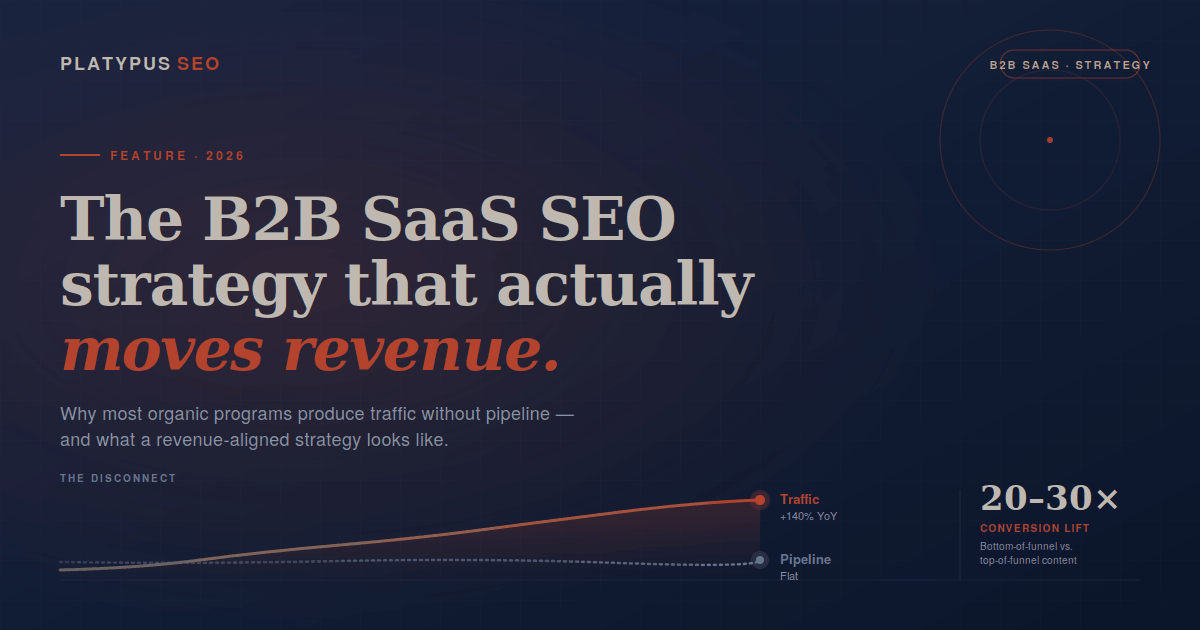
Every quarter, the same report lands on the CEO’s desk. Organic traffic is up 140 percent year over year. Non-branded sessions are growing. Rankings for the target keyword list look healthy. Marketing has done the work.
And underneath it, another report. Inbound demo requests are flat. Qualified pipeline from organic search has not moved. The sales team is still chasing outbound. The SDRs have not noticed a difference.
If you’re the person those two reports are addressed to, you already know the conversation that comes next. Marketing defends the traffic growth. Sales questions the quality. Finance asks what the channel is actually returning. And no one in the room can answer the underlying question i.e., whether SEO investment is producing ROI or producing the appearance of progress.
This is the disconnect most B2B SaaS companies are living inside right now. The problem isn’t measurement – it’s strategy. SEO as it’s most commonly practised in B2B SaaS is optimised for traffic, not for pipeline, and in B2B SaaS those two outcomes are sometimes inversely correlated. A campaign can be excellently executed against the wrong objective and produce nothing the board will ever care about.
We’ve written this piece to demonstrate what changes when SEO is treated as a revenue system instead of a traffic channel. Specifically: why the traditional playbook fails in B2B SaaS, what a strategy built around GTM and ICP actually looks like, how AI search has shifted what “organic visibility” means in 2026, and how to know whether any of it is working. None of this is a how-to. If you want tactics, there are a thousand articles about keyword research already. This is about what the keyword research is supposed to be for.
Why most B2B SaaS SEO programs fail to produce pipeline
The failure mode is consistent across companies. The reporting metric is sessions. The production metric is published posts per month. The strategy (if one exists on paper) is a keyword list sorted by search volume. Every one of these is a symptom of the same underlying mistake: treating SEO as a top-of-funnel traffic activity disconnected from the sales motion.
This made sense historically. SEO grew up in B2C and early blog-era marketing, where traffic volume was a reasonable proxy for commercial intent. A retailer selling running shoes could plausibly convert a share of any visitor who searched “best running shoes for marathons.” The economics worked because the purchase was impulsive, the ticket size was small, and the buyer was the user.
None of that describes B2B SaaS. Your buyer is not the user. The purchase is not impulsive. The ticket is $20K to $200K in ARR. The decision involves three to seven stakeholders. And a prospect searching “what is CRM” is not in-market – they’re a student, a junior employee, or a curious founder three years away from buying anything.
A prospect searching “best CRM for personal injury law firms under 20 attorneys” is in-market. Those two searches sit ten index points apart on a keyword research tool and produce fundamentally different commercial outcomes. Run a program against the first kind of query and you get what most B2B SaaS companies have: traffic growth, flat pipeline, and eventually a leadership team that loses faith in the channel.
The failure is not execution. It’s framing. A program can be excellently executed against the wrong objective and still produce zero pipeline.
Here’s a scenario. A B2B SaaS company had published over 200 blog posts, generating roughly 15,000 monthly organic visits. From that traffic, the sales team was receiving three qualified leads per month. Conversion rate from visitor to lead: under 0.02 percent. The traffic was real. The commercial fit was not.
This is not a fringe outcome. It’s the median experience of content-led SEO in B2B SaaS. What most programs are optimising toward volume at the top of the funnel, with comparison and decision-stage content treated as an afterthought. This is almost perfectly inverse to what produces pipeline.
The visitors who convert into demos at 5 to 10 percent are not reading “what is X” articles. They’re searching for comparison pages, competitor alternatives, pricing, and use-case-specific solutions. Most of those pages either do not exist on the average SaaS site or exist as thin, outdated, neglected afterthoughts.
What a revenue-aligned B2B SaaS SEO strategy is actually built on
A strategy that moves revenue is not a better keyword list. It’s a sequence of commercial decisions, made before any keyword research begins, and every one of those decisions comes from outside the SEO program. They come from how the company goes to market.
It starts from GTM, not from search volume
The first input to a real SEO strategy is the company’s go-to-market strategy. Who is the ICP. What the buyer personas look like inside it. What the ACV is. How long the sales cycle runs. What triggers a buyer to enter the market. Whether the motion is product-led, sales-led, or hybrid. If the person running SEO cannot answer these questions in a single conversation, the program is being built on sand — and no amount of technical competence downstream will fix that.
These answers determine everything that follows. A PLG product with a $5K ACV and a 14-day sales cycle rewards self-serve comparison pages, integration-specific landing pages, and content that accelerates trial activation. A sales-led product with an $80K ACV and a nine-month cycle rewards thought leadership that shapes category definitions, buying-committee enablement content, and material that arms an internal champion to sell the decision internally. The two programs share almost no overlap. Neither can be built from a generic keyword list.
This is the first thing most agency engagements get wrong. The intake is keyword-first instead of GTM-first. The deliverable is a content calendar instead of a commercial hypothesis. Twelve months later, the traffic chart looks good and the pipeline chart is unchanged.
It maps to the buyer’s journey, not the marketing funnel
The first input to a real SEO strategy is the company’s go-to-market strategy. Who is the ICP. What the buyer personas look like inside it. What the ACV is. How long the sales cycle runs. What triggers a buyer to enter the market. Whether the motion is product-led, sales-led, or hybrid. If the person running SEO cannot answer these questions in a single conversation, the program is being built on sand and no amount of technical competence downstream will fix that.
These answers determine everything that follows. A PLG product with a $5K ACV and a 14-day sales cycle rewards self-serve comparison pages, integration-specific landing pages, and content that accelerates trial activation. A sales-led product with an $80K ACV and a nine-month cycle rewards thought leadership that shapes category definitions, buying-committee enablement content, and material that arms an internal champion to sell the decision internally. The two programs share almost no overlap. Neither can be built from a generic keyword list.
This is the first thing most agency engagements get wrong. The intake is keyword-first instead of GTM-first. The deliverable is a content calendar instead of a commercial hypothesis. Twelve months later, the traffic chart looks good and the pipeline chart is unchanged.
It integrates positioning, not just keywords
Search isn’t a neutral channel. It’s where positioning either pays off or quietly fails. If the company’s positioning is undifferentiated (if the solution page says the same thing as twenty competitors, if the comparison page reads like a feature checklist) then ranking for those terms produces traffic that bounces. The best keyword strategy in the world cannot save a page that does not give the reader a reason to believe this company is different from the last one they evaluated. This is why the SEO function in a high-performing B2B SaaS company is either part of the positioning conversation or sitting directly downstream of it. Separate the two and the content will rank on technical merit while failing to move any reader toward a buying decision.
It treats commercial keywords as the core, not the fringe
Most SEO programs treat competitor comparison keywords, alternative keywords, and category-versus-category queries as an afterthought i.e., something to get to eventually, after the educational content is built out. This is backwards. These are the highest-converting, lowest-competition, fastest-to-rank keywords in the entire B2B SaaS landscape.
A buyer searching “[competitor] vs [competitor]” has already committed to solving the problem, shortlisted the category, and is choosing between vendors. If your company isn’t present on that page (whether by ranking for it, appearing in a third-party listicle that does, or being cited in AI responses that answer the same query) the deal is lost before the demo is ever booked. It’s lost in silence. Sales never hears about it because the buyer never reached out.The arithmetic is ruthless. In benchmark analyses across dozens of B2B SaaS programs, commercial bottom-of-funnel content has been shown to convert visitors to pipeline at 20 to 30 times the rate of top-of-funnel educational material on the same sites. Yet most programs allocate roughly the inverse: the majority of production capacity goes to educational content, and commercial pages get whatever is left. If the reader’s CRM is called Acme and the company does not rank for “Salesforce alternatives,” a meaningful share of the addressable market is making purchase decisions without ever knowing Acme exists.
The AI search shift: organic visibility no longer means what it did
Any honest discussion of B2B SaaS SEO strategy in 2026 has to address what has changed at the platform layer. This is not a sidebar. It’s now a structural input to the strategy, and ignoring it produces a program that is steadily losing ground even as its traditional metrics hold steady.
The share of buyer research happening inside ChatGPT, Perplexity, Claude, Google AI Overviews, and Gemini is no longer marginal. Recent industry surveys place the share of B2B buyers using large language models at some point in their purchase journey at roughly 94 percent. For problem-aware and category-level queries (the ones that used to be the natural home of SEO) AI interfaces are increasingly the first surface a buyer touches.
This changes two things about what “organic visibility” actually means.
The first is that traffic for informational queries is collapsing. AI Overviews and chat answers absorb the click. A question that would have produced a session on the company’s blog five years ago now produces a summarised answer inside ChatGPT, and the buyer never visits any site at all. Nearly 60 percent of searches now end without a click. That number will climb, not fall.
The second is that the question has shifted from “do we rank on Google?” to “are we cited by the model?” Those problems are related, but not identical. A recent study found that only about 12 percent of URLs cited in AI answers overlapped with the top 10 Google results for the same queries. The other 88 percent came from sources most traditional SEO programs have never prioritised: third-party review sites, industry listicles, analyst reports, Reddit threads, and peer publications. The practical implication is direct. Brand mentions on third-party platforms (G2, Capterra, “top X software for Y” listicles, niche community discussions, independent analyst coverage) now carry weight equivalent to, and in some categories greater than, traditional backlinks. These are not optional add-ons. They are what organic visibility inside Google AI Mode and the other LLM surfaces now requires.
The compensating data point is worth naming directly: AI-referred traffic converts at materially higher rates than traditional organic. The volume is lower. The quality is higher. Which is, not incidentally, the same lesson B2B SaaS SEO has been trying to teach itself for a decade, now being enforced by the platform layer.
The brands cited by the models today are the brands buyers consider tomorrow. Being absent is a compounding problem.
Why SEO cannot be run as a standalone channel
Even within a revenue-aligned framing, SEO run in isolation underperforms what it can achieve when integrated with the rest of the organic system. The channels that actually convert buyers in B2B SaaS work together. A prospect reads a blog post, sees the brand mentioned in a Reddit thread about the category, notices a post from the founder on LinkedIn, clicks a retargeting ad weeks later, reads a case study on the product page, and then books a demo. Attribution tools credit the last touch. The job was done by the system.
SEO, AI search optimization, content marketing, and conversion rate optimization are not four programs. They are four components of one organic growth system. Organic search drives demand capture. AI search optimization ensures the brand appears in shortlists buyers build before visiting any website. Content marketing gives the brand something worth citing, linking to, and remembering. CRO ensures the traffic that does land actually converts. Remove any one and the others underperform; and not by a little.
“Our SEO is not working” is, in most cases, a symptom of a fragmented organic program rather than a failed channel. The fix is rarely a better SEO agency. It’s a decision to treat the organic function as a single integrated system with shared ownership, shared metrics, and a shared pipeline target.
How to tell whether any of this is working
The measurement conversation usually happens last and matters most. It’s where the reader’s skepticism (earned from years of vanity-metric reporting) either gets resolved or deepens. Getting this part wrong is how otherwise-sound programs lose executive support.
The first shift is distinguishing diagnostic metrics from primary metrics. Keyword rankings, organic traffic, non-branded session growth, and domain authority are diagnostic. They tell you whether the mechanics are working i.e., whether pages are indexed, whether Google is surfacing them, whether the technical foundation is sound. They are not goals. They are the oil temperature and tire pressure, not the lap time. The primary metrics are pipeline from organic search, SQLs attributed to organic, organic-influenced ARR, and CAC payback from the channel. A program that is moving diagnostics without moving primaries is a program pointed at the wrong demand.
The second shift is accepting that attribution in B2B SaaS is genuinely hard, and no model is precise. Last-touch underweights organic. First-touch overweights it. Multi-touch models require deal volume most growth-stage SaaS companies do not have. The honest goal is not perfect attribution; it’s defensible direction. Is organic-sourced pipeline growing quarter over quarter? Is blended CAC from the channel improving? Is the set of keywords producing demos expanding? Those questions can be answered credibly even when the attribution math is imperfect.
Two practical measurement shifts matter more than any tool selection. First, stop measuring total organic traffic and start measuring traffic to a defined set of commercial pages; the pages that actually convert. The rest is context, not performance. Second, stop measuring MQLs from organic and start measuring SQLs and pipeline value. MQL volume is where vanity metrics hide. SQL and pipeline value is where the board conversation happens.
A third shift is quieter but increasingly urgent. The dark funnel is real and growing. Between AI-mediated research, private community shares, peer recommendations in Slack groups, and zero-click searches, a material share of the buying journey is now invisible to any attribution tool. The most useful compensating mechanism is cheap and nearly universally underused: a self-reported source field on the demo request form – “How did you first hear about us?” – left open-text rather than constrained to a dropdown. The answers reliably surface channels and content the dashboard never saw. Companies that implement this typically discover their organic program is producing 30 to 50 percent more influence than attribution gives it credit for. Knowing that changes how the budget conversation goes.
Finally, timelines. Honest expectation-setting matters here, and it’s the point at which most agency relationships either survive or fail. A well-built B2B SaaS SEO program produces pipeline signal inside three to six months. Meaningful compounding returns show up at nine to eighteen months. Any program promising significant pipeline in 30 to 60 days is either operating in an uncompetitive niche or misleading the reader, and either way the expectation is worth challenging before the contract is signed.
Companies with tightly aligned sales and marketing functions achieve 36 percent higher customer retention and 67 percent higher close rates than misaligned peers. The measurement problem and the revenue problem are often the same problem.
Organic search is a GTM capability now
The through-line in everything above is a single shift in how the channel is understood. B2B SaaS SEO is no longer a marketing tactic that can be delegated to a generalist agency, run from a keyword spreadsheet, and reported on in traffic terms. It’s a revenue system built on top of the company’s GTM strategy, ICP, and sales motion, and executed across search, AI, content, and conversion as an integrated program. Treating it as anything less produces the exact failure mode most readers of this article opened it already living inside: growing traffic, flat pipeline, and a quarterly conversation that never quite reconciles.
The shift to AI-mediated buying is accelerating, not reversing. The brands cited by the models today are the brands buyers consider tomorrow. The companies building a coherent organic system (starting from GTM and ending at measurable pipeline) are opening a structural cost-of-acquisition advantage over competitors still running SEO as a traffic program. In a 2026 funding environment where CAC efficiency is being scrutinised at every board meeting, that advantage is not marginal. It is the difference between scaling profitably toward Series C and stalling at the revenue plateau that ended a third of the growth-stage SaaS companies that were well-funded two years ago.
The question that matters at the end of a piece like this is not what to do next. It’s what to stop doing. Stop measuring the wrong metric. Stop producing the wrong content. Stop treating the organic channel as a cost centre delegated to whoever has capacity. The companies that are winning inbound in this cycle have already done each of those things. The ones that have not are running out of quarters in which to catch up.
Related Posts

SEO Strategies for Cybersecurity: What Actually Builds Pipeline
Your quarterly review lands and the SEO chart looks healthy. Organic traffic is up. Non-branded sessions are growing. The blog…

Dragan Veselinović
May 14, 2026
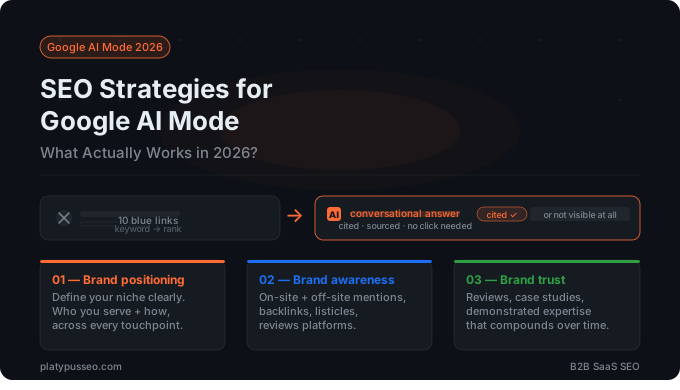
SEO Strategies for Google AI Mode: What Actually Works in 2026?
Generic SEO tactics won't cut it in Google AI Mode. Discover why brand positioning, awareness, and trust are the real…
Dragan Veselinović
Apr 8, 2026