

Assessing content quality and relevance is a critical aspect of an on-page SEO analysis, as it directly impacts the user experience and thus search engine rankings.
From an SEO perspective, the most important area that your content should initially address is the searcher’s intent.
It’s important to remember that at this stage, you’re taking a top-down approach. That means, looking at the overall picture to determine both the relevance and quality of your content.
In later steps, you will perform more detailed analysis of your content.
For now, you want to ensure that your content provides your target audience with information that’s relevant to what they’ve typed into a search engine.
In this guide, we’ll go over all the items you should consider when assessing the quality and relevance of your content, regardless of if it’s a landing page or an article – or otherwise.
Before we get into the finer details, here’s a basic check-list that you should go over when assessing the overall quality and relevance of your content.
Let’s look at the key factors to consider when evaluating content quality and relevance.
Does your content address your target market’s search intent?
Contact us to evaluate the quality and relevance of your content with respect to your customer’s search queries.
Relevance to Searcher Intent
Ensure that the content directly addresses the searcher’s intent by providing valuable information, answers to their queries, or solutions to their problems.
In plain English, this means: your content should address what the searcher has typed into Google (or another search engine).
To do this, you will want to refer to both your knowledge of your target market as well as the keywords that you have identified as important to the page you are evaluating.
Then, you want to align the content with targeted keywords and topics that match the user’s search intent i.e., the kind of information they’re expecting to find following their online search.
For example:
You may be reading this guide as you own or work for a SaaS brand and you want to know how to conduct an SEO audit for your SaaS website.
Let’s say, you typed “SEO audit SaaS” into Google. On the basis of the keyword, we’re assuming that you’re expecting to find extensive info on SEO audits in relation to SaaS websites.
So, we’ve created an entire content cluster addressing this topic, providing guidance on what it is and how you can do it on your own.
As you navigate through the cluster, you’ll find that we’ve covered the topic in great depth to help you out as much as possible.
Your aim should be the same ~ to address your target market’s query as directly as possible while providing maximum value as you do so.
Here are a few other examples of other websites, which we think have done a great job of addressing entire subject matters with relevant content.
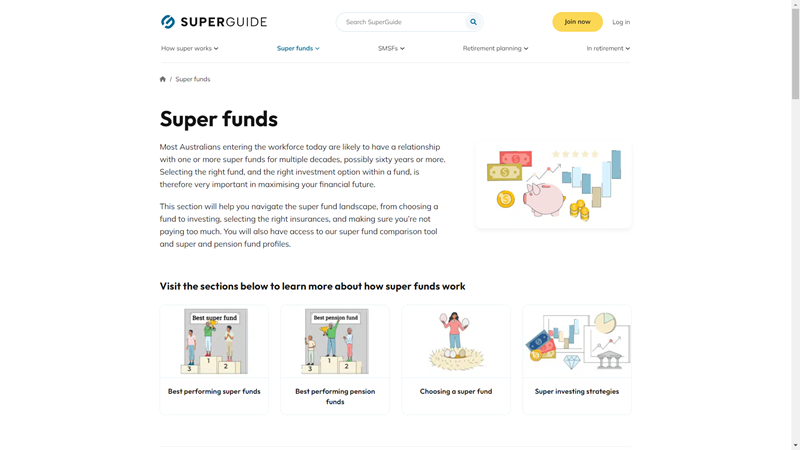
- SuperGuide: A comprehensive resource (organized as a content hub) on retirement fund options, including how to choose the best super fund, top performing super funds, super investing strategies, and more. Usually, someone will find this info by typing “super funds guide” into Google.
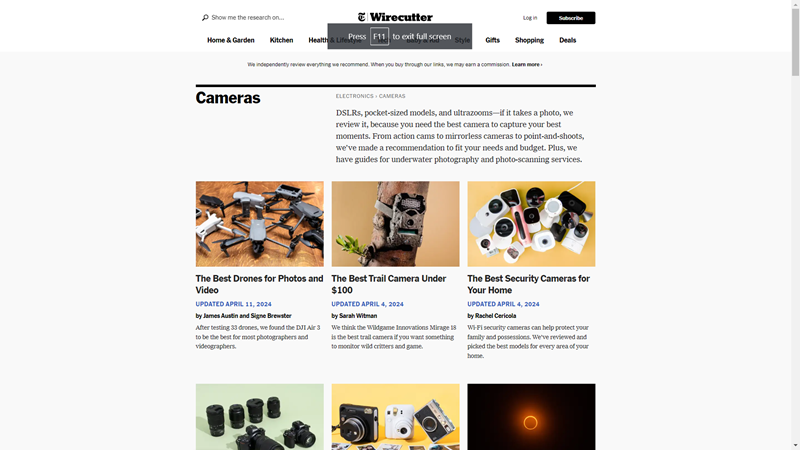
- NY Times | Wirecutter: As above, The NY Times has created a content hub on cameras with extensive guides on camera-related topics within e.g. the top 3 instant cameras and how to photograph a solar eclipse. Usually, people in the USA searching “best digital camera” will find this page on Google.
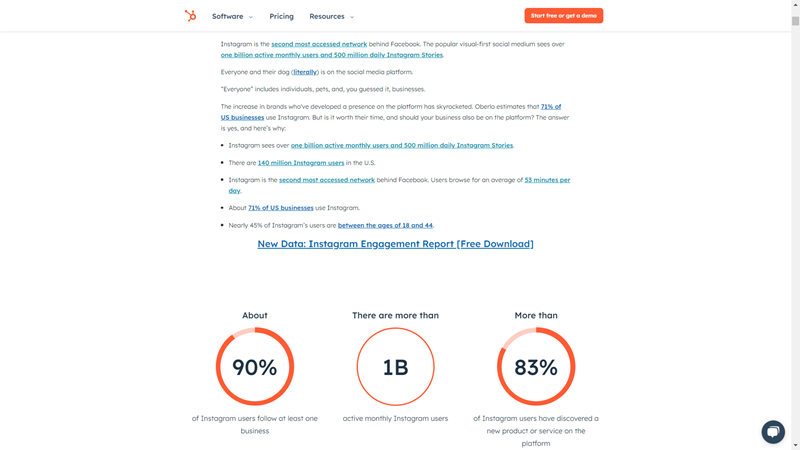
- Hubspot: A different approach, Hubspot has created long-form content i.e., one humongous piece detailing all there is to know about Instagram marketing. As you may guess by now, someone typing “instagram marketing” would likely find this page via Google’s search results.
Another example could be
You have a very specific problem that requires solving, like: adding a title tag to your WordPress website.
Again, you type something along the lines of “how to add a title tag to my WordPress website?” into Google, and you find this article.
Within, you’ll find quite a clear, direct and descriptive guide written by WordPress themselves.
So, if you’re looking to answer a particular question that your target audience may ask, do so in a manner that’s clear, direct and descriptive.
Here are some more examples answering specific questions:
- SEMRush: Here is a long winded one-page guide on how to conduct keyword research using SEMRush for people looking to do just that.
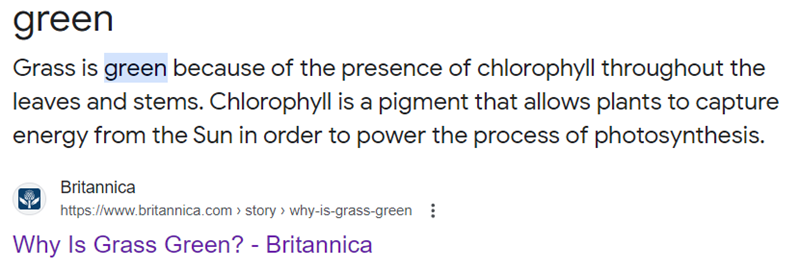
- Britannica: On the other hand, we have Britannica answering the question why grass is green in approximately 100 words. Sometimes, there’s no need to ramble on. In fact, Britannica’s straightforward approach has earned them the following first-place result on Google for the question “Why is grass green?”.
- Cycling News: Finally, we have something in between; Cycling News telling us how to change a bike tyre with numbered and detailed steps throughout the article. For the search query “how to change a bike tyre”, their efforts have gotten them the result pictured below.
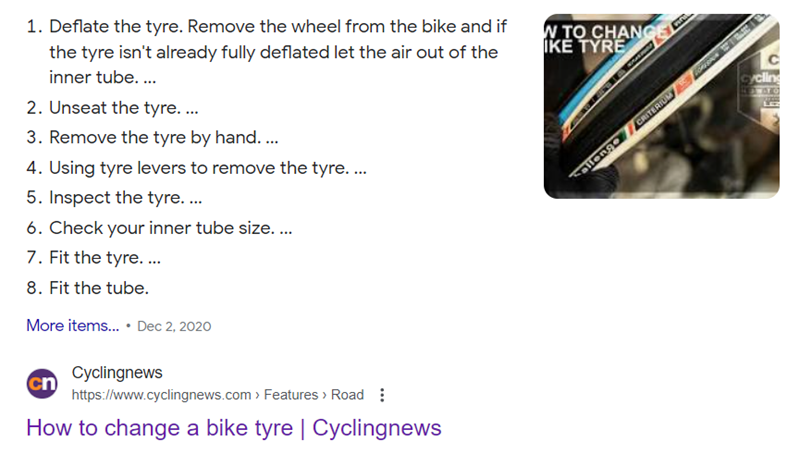
When you’re answering questions, it’s important to note: These don’t have to be long-winded articles. Oftentimes, just answering the question directly is enough – as you would have noticed above.
That’s why you’ll often find forums like Quora or Reddit atop search results when you’re typing very specific questions into search engines like Google.
In addition: results may differ for desktop and mobile. So, for the query “how to change a bike tyre” you may see more Youtube videos pop up in search results, as pictured below. In addition, different website may pop up if they’re better optimized for the mobile experience.
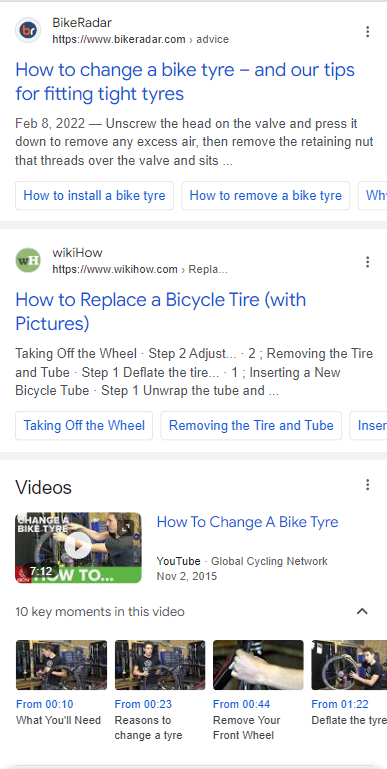
We’ll discuss optimizing for mobile in greater detail in another article. So, keep this in the back of mind for now, and let’s focus on what’s most important i.e., relevance to the searcher’s intent.
Finally
Let’s use ourselves (Platypus SEO) as an example once more, and you, our target audience, are looking for a solution (service/good) to purchase e.g., a B2B SaaS SEO agency.
Well, our homepage might just be a great example, as it’s a landing page containing information detailing just what the searcher was looking for.
You’ll find, that we provide comprehensive information on:
- What our solution is
- How it benefits you
- How it works (the process)
- How you fit in
- Why you should believe us
- And we also answer some frequently asked questions.
Adopting such an approach yourself will provide your target market with a clear understanding of your solution and how it will help them.
Here are a couple of more examples that we’ve found on the next that we think work quite well.
- PIXLR: The first result that pops up on Google when we type “ai photo editor”, PIXLR includes information about what their product is, its benefits, features and more.
- Pay Calculator: Directed at the Australian market searching for a “pay calculator” this landing page is straight to the point, and simply provides little more than the calculator itself.
- Convertio: Similar to Pay Calculator above, Convertio provides customers with a tool enabling file conversion right atop their page and little else.
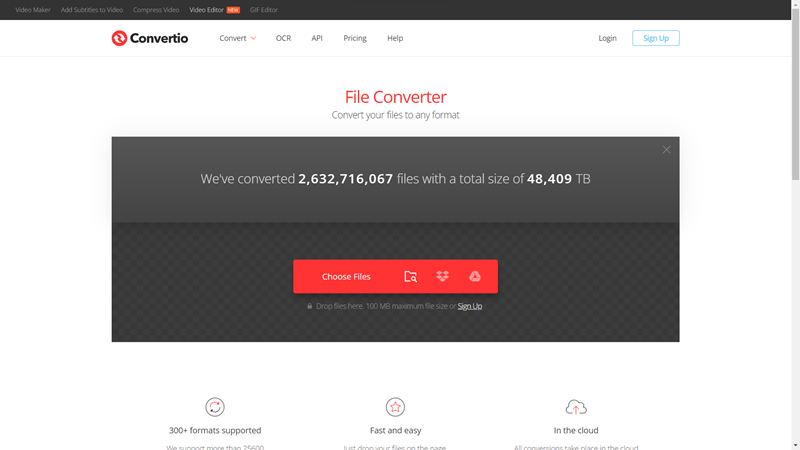
Remember! Assessing content quality and relevance is a very top-down approach. When it comes to relevance to searcher’s intent, the main question you’re asking yourself here is:
Am I putting forward content that is providing my target audience with what they’re after?
If you’re doing that then great! Let’s move onto the next step.
Depth and Breadth of Coverage
As with all things in SEO, the depth and breadth of coverage depends on the searcher’s intent. A good way to approach whether a piece of content should be long or short is to ask yourself:
What would I expect to find if I typed exactly this search into Google?
If you think that the query is fairly straightforward and requires a straightforward answer, like a calculator, then there’s no point in creating long content.
On the other hand, landing pages for services may require longer content; so that you may outline to your target market: what the service is, how it benefits your customers, how it works, what features it has etc.
Finally, tackling entire subject matters will often require longer pieces of content or content clusters.
So with all that said, evaluating the depth and breadth of content coverage is another way of saying that you’re giving comprehensive coverage to the topic at hand.
That doesn’t mean that all of your content needs have a minimum word count. Think of depth and breadth more as quality of information rather than quantity.
Originality and Uniqueness
Assess the originality and uniqueness of the content to avoid duplication or plagiarism.
We’ve already talked about duplication and how it can hurt your SEO efforts, and all we’ll say about plagiarism is that Google will punish you just like your school teacher when they catch you.
To check whether your content is unique and original then you can use the following tools:
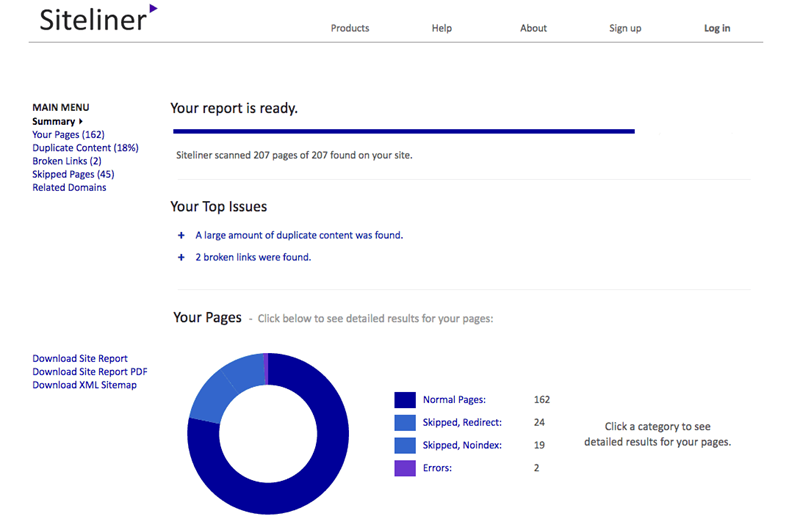
- Siteliner: to check how unique your content is versus other content on your own site.
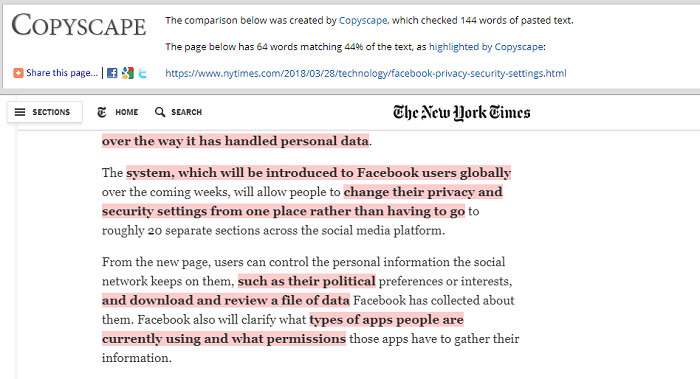
- Copyscape: to check if your content is similar to other content on the web.
You want your website to contain 100% original and valuable content that offers a fresh perspective, new insights, or unique solutions.
Siteliner
Using Siteliner, you can see how much duplicate content there is on your website. Ideally, you want all indexed content to be unique.

Copyscape
Put in your URL or even copy/paste text into CopyScape,and they’ll scour the entire web to reveal any and all similar content pieces out there. Search engines like Google place great value on original content.

Engagement and Readability
Analyze the readability and engagement level of your content to ensure it resonates with your target audience.
Some tools you can use for measurement include:
- Google Analytics: to see how long people are hanging around on your page for. Read our guide on examining use engagement metrics to see how you can get to this information.
- Yoast SEO (plugin for WordPress websites): To see readability scores and other similar metrics. Yoast themselves have written a guide on how to see the readability score of a piece of content.
With that latter suggestion (Yoast), use the plugin as a guide and don’t rely on it completely. It’s far better to employ sound content writing techniques in order to boost readability.
They include:
- Write for your target market and not to please search engines
- Use shorter sentences and break up paragraphs
- Employ the active tone instead of the passive tone in your content writing
Overall, You want to make sure your site uses clear, concise language; that content is broken up into digestible chunks, and that it incorporates multimedia elements (e.g., images, videos, infographics, charts etc.) to enhance both readability and engagement.
Evergreen and Timeliness
Finally, you want to ensure that your content remains relevant and valuable over time. Having evergreen content on your website means writing in a way that its timeliness is always relevant.
For example: Instead of writing, “This year we established our company”, you could instead write “Our company was established in 2024”. The fact will never change and you don’t need to edit your content every year.
Naturally, it won’t always be appropriate for your content writing to be evergreen, and when it’s not, you should make timely updates.
For example: Let’s say you’re writing the Ultimate Guide to the Latest Instagram Marketing Tactics. At the time of writing this guide, it’s 2024 and the next year will be 2025. In order to remain timely, you would update this guide year-on-year to reflect best practices during the year in which you are writing.
Strive to create evergreen content that remains relevant and valuable over time, while also incorporating timely updates and fresh insights to stay current with industry trends and developments.
By prioritizing content quality and relevance in on-page SEO analysis, website owners and content creators can enhance user experience, improve search engine rankings, and ultimately drive more traffic, engagement, and conversions on their websites.
Re-cap: High content quality and relevance are your starting point
This should definitely be one of the first steps you take as part of your SEO audit. Once you’re aware of the keywords you’re targeting, assessing how well you’re targeting those keywords and presenting information to website visitors is the logical next step.
There are several key factors to consider when evaluating the quality and relevance of your content. In summary, there are:
- Your content needs to align with the searcher’s intent, and the content you write should address their query directly in a high quality manner
- Your content should be original and unique, easy to engage and readable, and should either be relevant over the long-term or be the subject of timely updates
Focusing on these aspects as you audit your SaaS website will lead to an enhanced User Experience, which SEO practices are ever increasingly intertwined with.