
For many B2B SaaS companies, the traditional SEO model is no longer a fit. Too many SEO companies still sell traffic growth, search rankings, and reporting as the end goal. But in a high-growth SaaS business, vanity metrics do not generate pipeline.
A serious software brand needs an SEO partner that understands long sales cycles, high intent keywords, and the technical complexities that turn search demand into demos, trials, and revenue. The best B2B SaaS SEO agencies look beyond online visibility; they prioritize qualified leads across both traditional search engines and emerging AI search platforms.
This guide compares ten SaaS SEO agencies with distinct specialisms, from technical SEO and content strategy to generative engine optimization, to help your team find the right match for your stage and goals.
Common Characteristics the Best Agencies Share
Choosing an SEO partner means looking beyond rankings alone. To deliver measurable results, the top-performing agencies share several critical characteristics.
Deep B2B SaaS Understanding
An agency needs to understand how software companies actually grow. This involves navigating long sales cycles, managing multiple stakeholders, and knowing the difference between product-led and sales-led motions. They should be experts in category creation and demand capture, building content for features, use cases, and competitor alternatives.
Technical SEO Strength
For B2B SaaS, technical health often dictates the performance ceiling. Complex site structures and documentation hubs frequently lead to crawl inefficiency, indexation hurdles, and missed page discovery. A strong agency ensures your website performance is optimized for these unique challenges.
Keyword Research Tied to Revenue
The best SaaS SEO agencies prioritize keyword research that focuses on commercial intent. Instead of chasing website traffic for its own sake, they target high intent keywords that correlate with demos, free trials, and sales pipeline. The strongest agencies also treat SEO as part of a wider growth system, connecting search visibility with messaging, conversion paths, and revenue reporting rather than reporting on rankings in isolation.
AI Search Readiness
As buyers adopt AI search tools, brands need enhanced visibility beyond standard links. Leading SEO companies now utilize generative engine optimization (GEO) to ensure your brand is cited by AI assistants when buyers evaluate vendors.
Our Pick: The 10 Best B2B SaaS SEO Agencies in 2026
Before we go through every agency in greater detail, we’ve provided a quick overview of each via the table below.
| Agency | Best for | Standout strength |
| Platypus SEO | Growth-stage SaaS | Revenue-aligned SEO, AI visibility, Content marketing, CRO |
| Directive | Enterprise teams | Customer Generation and pipeline focus |
| Skale | Chasing ARR growth | Revenue-focused SEO & AI search |
| Omniscient Digital | Organic growth systems | SEO, GEO, and editorial strategy |
| MADX | Technical depth & GEO | Performance-led SEO + AI search |
| First Page Sage | Established firms | Thought leadership and long-term SEO |
| Embarque | Scalable execution | AI visibility and scalable execution |
| Flying Cat Marketing | Holistic buying journeys | Content strategy and buyer-journey focus |
| POLARIS | Technical SEO & PR | Technical depth and digital PR support |
| Gripped | Integrated demand gen | Integrated demand generation support |
Now let’s dive in.
1. Platypus SEO
Best for: Growth-stage European B2B SaaS companies that want revenue-aligned organic growth tied to qualified pipeline, demos, free trials, and stronger visibility across both traditional and AI-driven search.
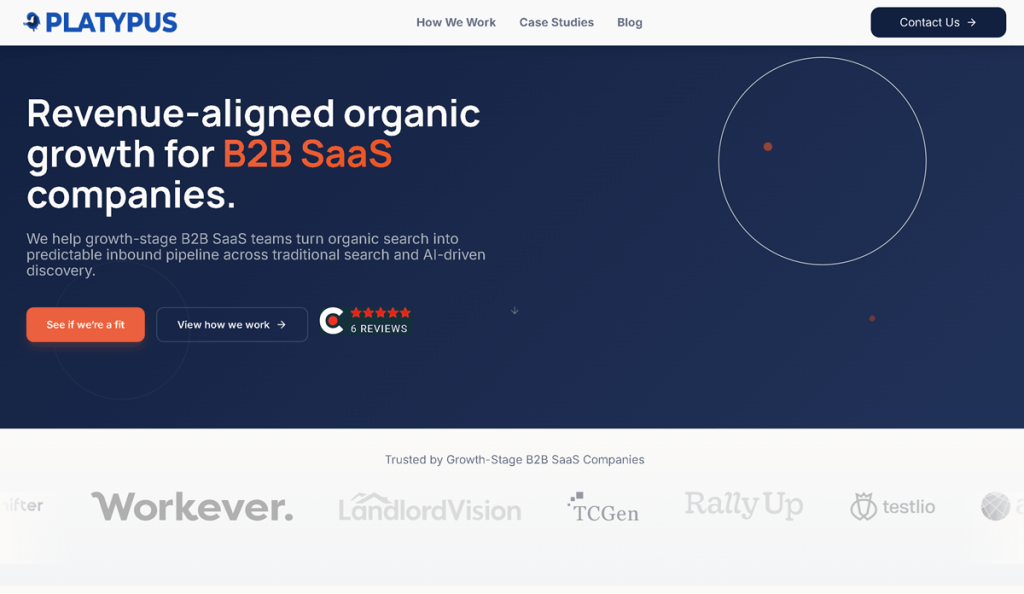
Platypus SEO is built for European B2B SaaS companies that need organic search to deliver scalable inbound pipeline. The B2B SaaS SEO agency operates with a revenue-first mindset, aligning every initiative with their clients’ go-to-market strategies and commercial objectives, and measuring success in qualified pipeline, revenue and ROI on SEO.
Their team functions as a deep extension of their client’s internal marketing and growth functions, taking strategic ownership of campaign outcomes rather than operating as a detached vendor. For B2B SaaS brands that want a senior-led partner accountable to pipeline contribution, that positioning is a genuine differentiator.
Platypus is also well-positioned for the 2026 search landscape through its combined focus on traditional SEO and AI search optimization (AEO/GEO), helping clients win visibility across Google, Bing, ChatGPT, and Google AI Mode in parallel.
Core Services
- Search Engine Optimization
- AI Search Optimization (AEO / GEO)
- Content Marketing
- Conversion Rate Optimization
Potential Limitation
Because they are highly specialized in growth-stage SaaS, Platypus is less suited for brands seeking broad digital marketing support or short-term, low-intent web traffic.
2. Directive Consulting
Best for: Mid-market and enterprise B2B SaaS brands that want SEO integrated into a broader pipeline generation system.
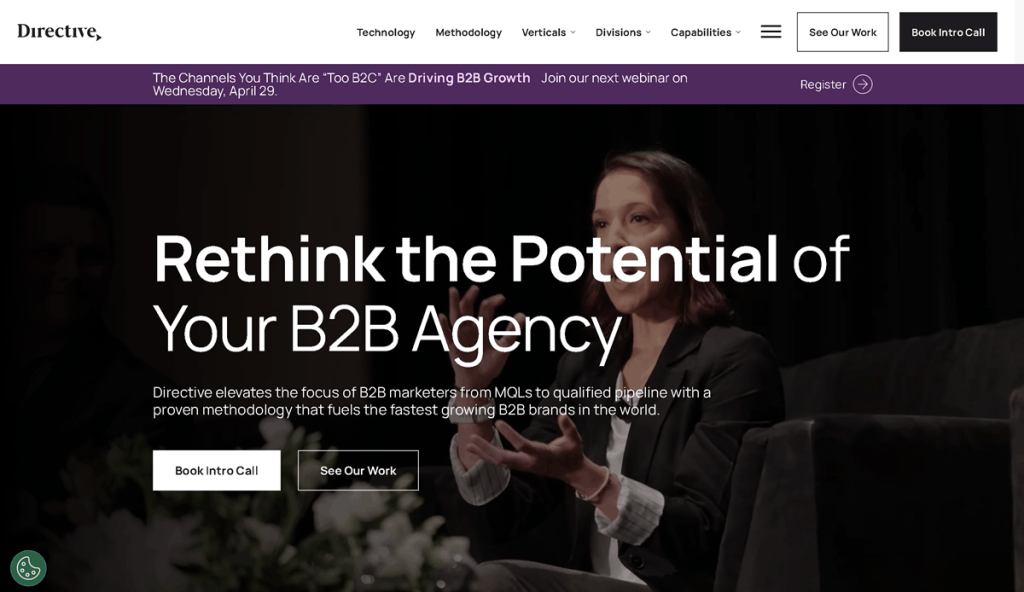
Directive has built a strong reputation in the B2B SaaS space by framing its services around its proprietary “Customer Generation” framework. This approach is designed to move the needle on financial metrics like customer acquisition costs (CAC) and lifetime value (LTV) rather than just ranking positions. They excel at working within complex, multi-layered marketing departments where SEO needs to be tightly aligned with paid media and performance marketing.
Their methodology is highly analytical, providing the kind of sophisticated, board-level reporting that enterprise software companies require. By treating organic search as a performance channel, they help large-scale brands identify which high intent keywords are actually contributing to bottom-line revenue. This makes them a reliable choice for established firms that have moved past the initial growth phase and now need to optimize their search presence for maximum capital efficiency and predictable pipeline growth across global markets.
Core Services
- B2B SEO & PPC services
- Conversion optimization
- Broader marketing strategy
Potential Limitation
Directive’s enterprise orientation and broad service suite may be more than a smaller, leaner SaaS company requires if they are looking for a highly specialized SEO specialist.
3. Skale
Best for: B2B SaaS companies focused on using SEO to close a specific ARR or MRR gap.
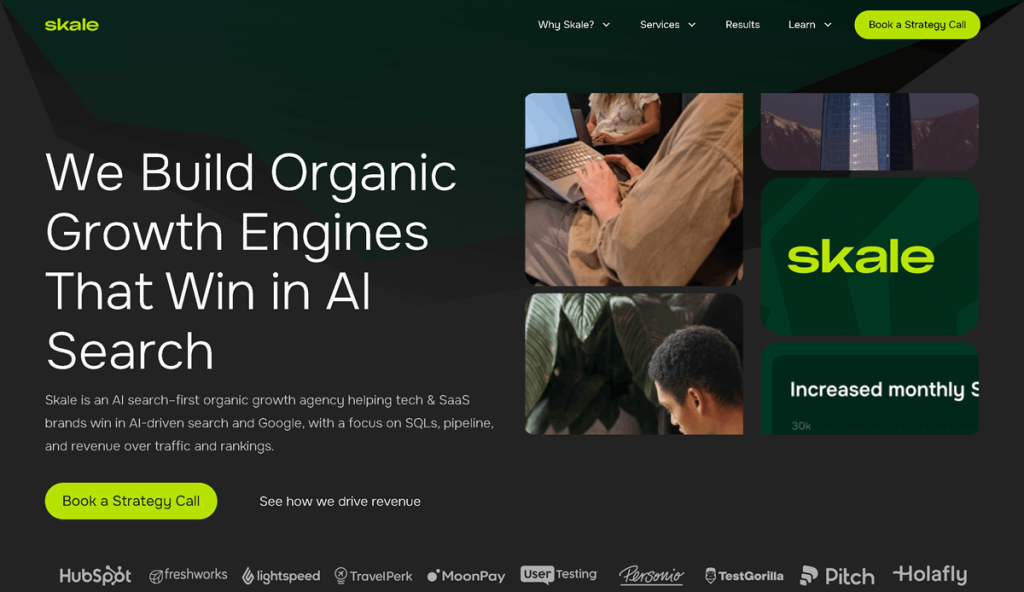
Skale stands out because it speaks the language of SaaS growth more directly than many traditional SEO agencies. Its positioning is built around revenue, MRR, ARR, and pipeline contribution, which makes it especially relevant for software companies that need to justify SEO in commercial rather than purely marketing terms. That gives the agency a sharper appeal for teams under pressure to connect search performance with actual growth outcomes.
It also feels highly aligned with the priorities of modern SaaS buyers. Instead of treating SEO as a content production exercise, Skale tends to frame it around identifying the queries, pages, and technical improvements most likely to move sign-ups, trials, and bottom-line performance. For SaaS brands that want a partner with a growth-led mindset, that focus is one of its biggest strengths.
Core Services
- SaaS SEO strategy
- Technical SEO & Link building
- Revenue-focused content
Potential Limitation
While they are excellent for revenue-led growth, brands that require extensive support in non-SEO areas like email marketing or social media marketing may find their focus too specialized.
4. Omniscient Digital
Best for: B2B software companies that want SEO and content to function as a long-term growth engine.
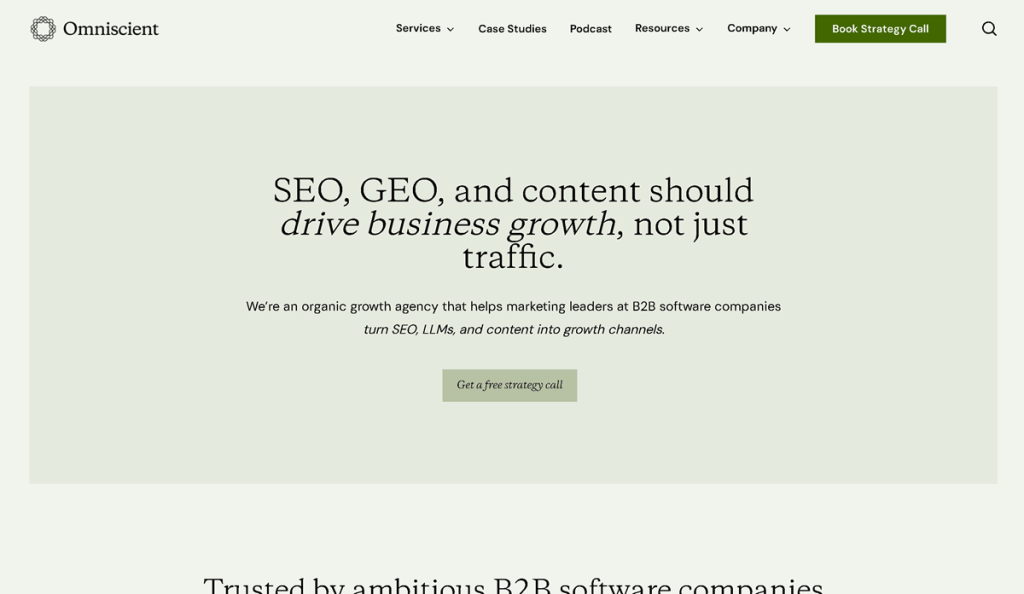
Omniscient Digital is great for brands that see content as a long-term growth asset rather than a supporting tactic. Its positioning is well suited to B2B software companies that want to build authority over time through strong editorial strategy, useful educational content, and durable organic visibility. That makes it a natural fit for teams operating in complex categories where trust and expertise shape buying decisions.
Another strength is the way Omniscient blends SEO with broader organic growth thinking. It is not simply about publishing more articles. The appeal lies in building a repeatable content engine that improves visibility, supports category authority, and strengthens buyer education across the funnel. For B2B SaaS brands that want SEO and content working as one system, that is a compelling proposition.
Core Services
- Content strategy & Execution
- Generative Engine Optimization (GEO)
- Technical SEO
Potential Limitation
Their strategy-heavy, consultative approach may feel slower for brands that require rapid, high-volume execution without a deep strategic layer.
5. MADX
Best for: SaaS brands that want a performance-led mix of technical SEO and AI search optimization.
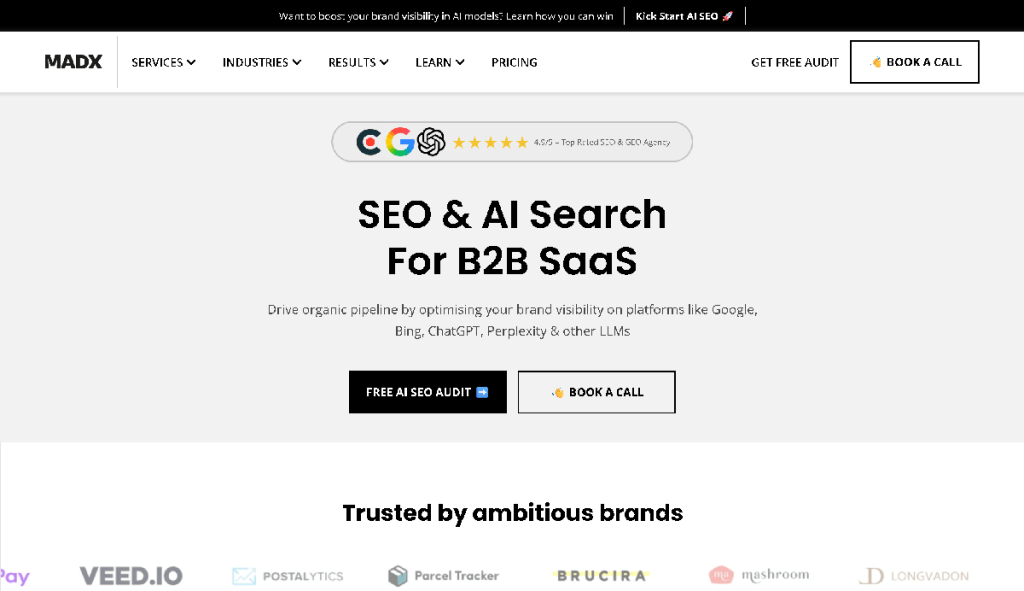
MADX feels more aggressively performance-led than many traditional agencies in this space. Its positioning leans into technical SEO, authority building, and AI-era search visibility, which makes it attractive to SaaS companies operating in crowded or fast-moving markets. For brands that want a partner with pace, urgency, and a strong bias toward action, that can be a major plus.
It also offers a more modern framing of search than agencies still anchored mainly in legacy SEO language. By bringing together technical work, content scaling, and AI search visibility, MADX is appealing to companies that want to compete across both classic search results and newer answer-driven environments. That gives it relevance for teams that see search change as something to lean into, not react to slowly.
Core Services
- SaaS SEO & GEO
- Technical SEO audits
- Digital PR & Link building
Potential Limitation
The proactive, performance-focused pace of MADX may feel more like a performance-marketing firm than a consultative strategic partner for some brands.
6. First Page Sage
Best for: Established software companies looking for long-term SEO rankings and thought leadership.
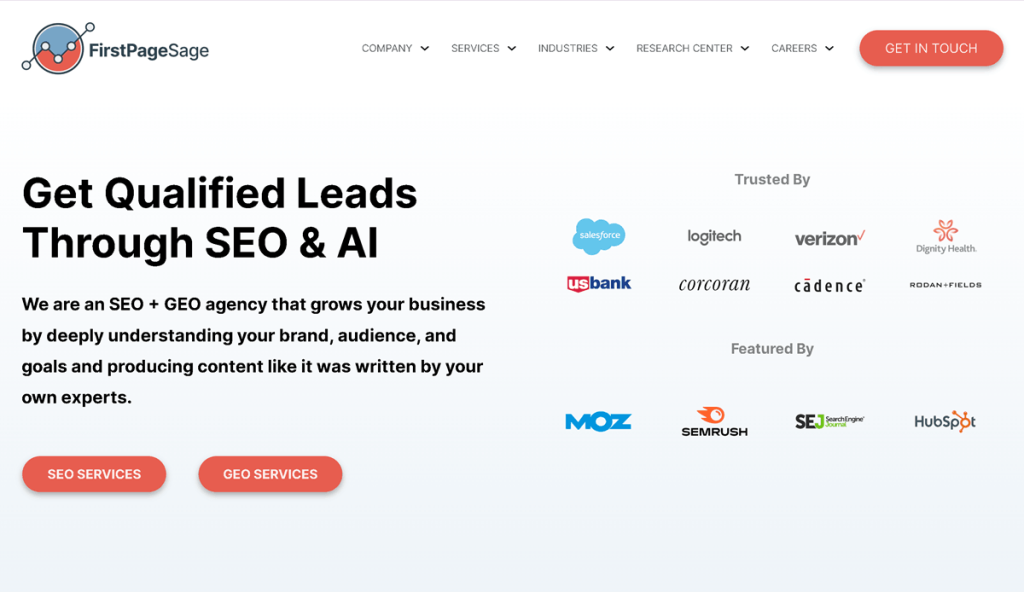
First Page Sage is a different flavor of SEO from the more aggressive growth-led agencies. It is better suited to established software companies that want to build category leadership over time and are willing to invest in expert-driven content that compounds in value rather than chasing fast tactical wins.
That slower, more structured model will appeal to some organizations more than others. For mature brands with longer planning horizons and a preference for proven processes, it offers a strong sense of stability. The value here is not only in rankings, but in building a body of content that reinforces trust and keeps generating qualified traffic well into the future.
Core Services
- Thought leadership SEO
- Technical SEO
- Competitive analysis
Potential Limitation
This model may be less suitable for early-stage B2B SaaS companies that need more agile growth levers or a heavier focus on AI-visibility.
7. Embarque
Best for: SaaS teams seeking enhanced visibility through scalable execution and AI citations.
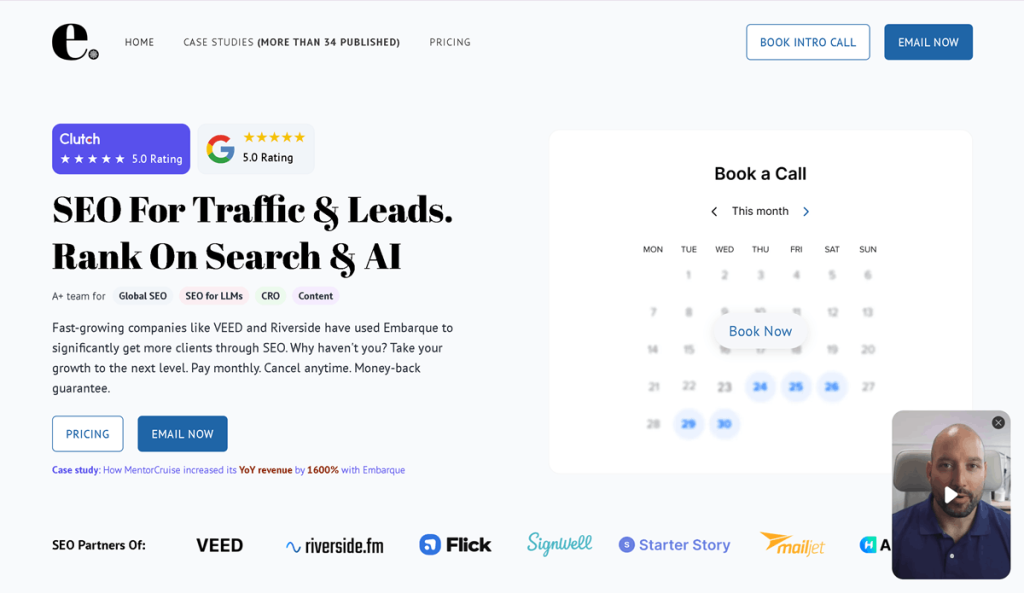
Embarque focuses on teams that value scalability and modern search visibility. Its positioning is particularly relevant for SaaS companies that want to cover a large search footprint efficiently, while also improving their presence across AI-driven search environments. That makes it attractive for businesses with broad product sets, multiple use cases, or a need to create landing pages and supporting content at pace.
Its appeal is also practical. Rather than wrapping SEO in overly abstract strategy language, Embarque feels more execution-oriented. For companies that want forward-looking search support with a clear emphasis on scalable delivery, programmatic opportunities, and AI visibility, that focus gives it a distinct place in the list.
Core Services
- Programmatic SEO
- Content marketing at scale
- AI search visibility (GEO)
Potential Limitations
While highly effective for execution and scale, some buyers may prefer a partner with a deeper strategic layer or a heavier focus on conversion rate optimization.
8. Flying Cat Marketing
Best for: SaaS brands where content systems and buyer-journey alignment are the primary growth drivers.
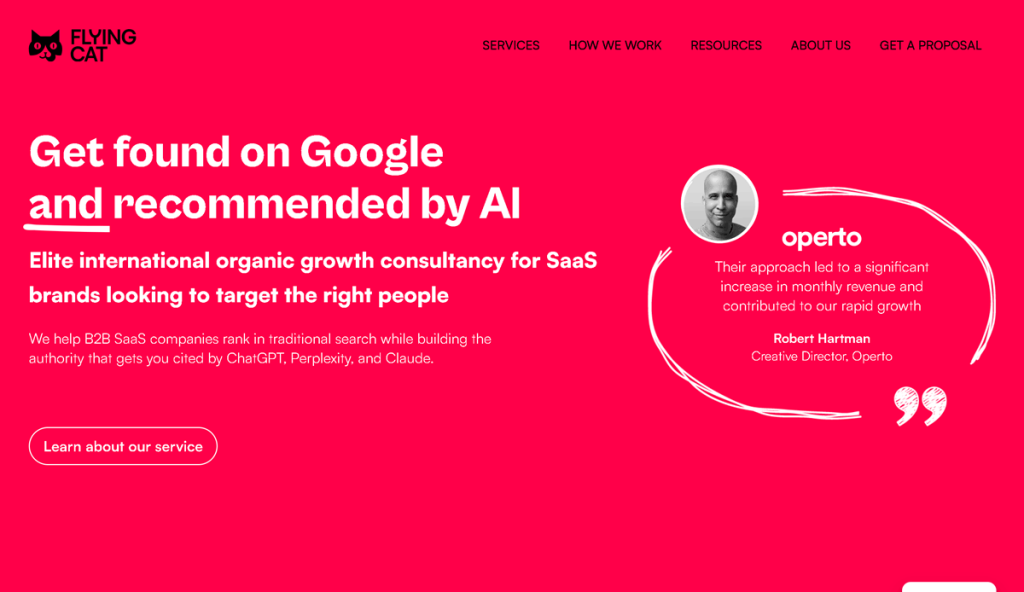
Here, you need look no further than its buyer-journey focus. It is a strong option for SaaS companies that do not want content created in a vacuum, but instead want it mapped carefully to the questions, objections, and comparisons buyers work through before converting. That gives the agency real relevance for brands where education plays a major role in the path to revenue.
Its research-led tone is also part of the appeal. Flying Cat feels best suited to teams that want editorial quality, strategic content planning, and a stronger understanding of how content supports evaluation-stage demand. For SaaS brands that see SEO as a trust-building and buyer-enablement function, that positioning makes sense.
Core Services
- Content strategy & Production
- Buyer journey mapping
- SaaS SEO execution
Potential Limitation
Brands with deep-seated technical SEO issues may need to ensure they have the internal resources to complement Flying Cat’s editorial-heavy focus.
9. POLARIS
Best for: B2B brands that want a partner with technical depth and recognized digital PR expertise.
POLARIS is all about combining technical SEO depth with digital PR capability. That mix is useful for B2B SaaS brands that need more than on-page improvements and content production. In competitive markets, visibility is often shaped by both technical foundations and external authority signals, and POLARIS is positioned to support both sides of that equation.
It also offers a slightly broader profile than some pure-play SaaS SEO agencies. That can make it appealing to brands that want a partner capable of handling technical complexity while also strengthening brand credibility through off-page work. For companies that value both search performance and authority building, that combination is a meaningful differentiator.
Core Services
- Technical SEO
- Digital PR & Link building
- SaaS SEO strategy
Potential Limitation
As an agency that works across several technical sectors, they may feel less specialized in “SaaS-only” nuances compared to pure-play software agencies.
10. Gripped
Best for: B2B SaaS and AI companies that want SEO as part of an integrated demand generation system.
Gripped is largely aimed at companies that want SEO integrated into a broader demand generation framework. Its appeal is strongest for B2B SaaS and AI firms that do not want organic search treated as a silo, but as one part of a wider growth engine alongside paid media, website performance, and conversion work. That makes it a sensible fit for teams looking for more breadth from a single partner.
It is also a useful option for companies that want commercial alignment without hiring multiple specialist agencies at once. Instead of focusing on SEO in isolation, Gripped is better positioned for brands that want closer coordination across acquisition channels. For some buyers, especially those building out demand generation systems more broadly, that wider support will be more valuable than a narrower SEO-only approach.
Core Services
- Integrated SaaS SEO & GEO
- Paid media & PPC services
- Web development & CRO
Potential Limitation
For companies looking for a “pure” SEO specialist that focuses on nothing else, a multi-service agency like Gripped may provide more breadth than is required.
Which B2B SaaS SEO Agency is Right for Your Company?
The right SEO partner depends on your current maturity and commercial goals:
- Choose Platypus SEO if… You are a growth-stage European B2B SaaS company that wants a senior-led partner accountable to qualified pipeline across both traditional and AI search.
- Choose Directive if… You are an enterprise brand needing a large-scale, integrated marketing strategy.
- Choose Skale if… You want a partner with a clear mindset focused on ARR and MRR growth.
- Choose Omniscient or Flying Cat if… Thoughtful, editorial-led organic growth is your primary advantage.
- Choose MADX or Embarque if… You want to be at the forefront of AI search and scalable technical execution.
Why B2B SaaS Companies Need Specialized SEO
In B2B SaaS, traditional SEO is often a wasted investment. Standard agencies focus on traffic growth for high-volume, top-of-funnel keywords. However, for a software firm, 1,000 visitors searching for a generic term are often less valuable than 10 visitors searching for a specific solution.
SaaS SEO requires a specialized approach due to:
- Long Sales Cycles: Content must nurture leads over months, not just drive a quick purchase.
- Multiple Stakeholders: Your SEO strategy must address the technical needs of developers and the ROI needs of leadership.
- Revenue Accountability: Moving past vanity metrics to report on qualified leads and actual customer acquisition costs.
By partnering with an agency that has a deep understanding of these dynamics, you ensure that every part of your search presence – from technical SEO to generative engine optimization – is designed to drive measurable business outcomes. To talk through your tailored SEO strategies, speak to our team today. The right fit depends on your growth stage, internal capabilities, and how closely you need SEO tied to pipeline and revenue.
Related Posts
9 Best First Page Sage Alternatives in 2026
First Page Sage alternatives compared: pricing, contract terms, AI search readiness, and how to pick the right fit for your…

Dragan Veselinović
Jun 13, 2026
10 Best SimpleTiger Alternatives for SEO / AEO in 2026
Compare the 10 best SimpleTiger alternatives from B2B SaaS specialists to technical, ecommerce, content, and local search experts.
Dragan Veselinović
May 29, 2026